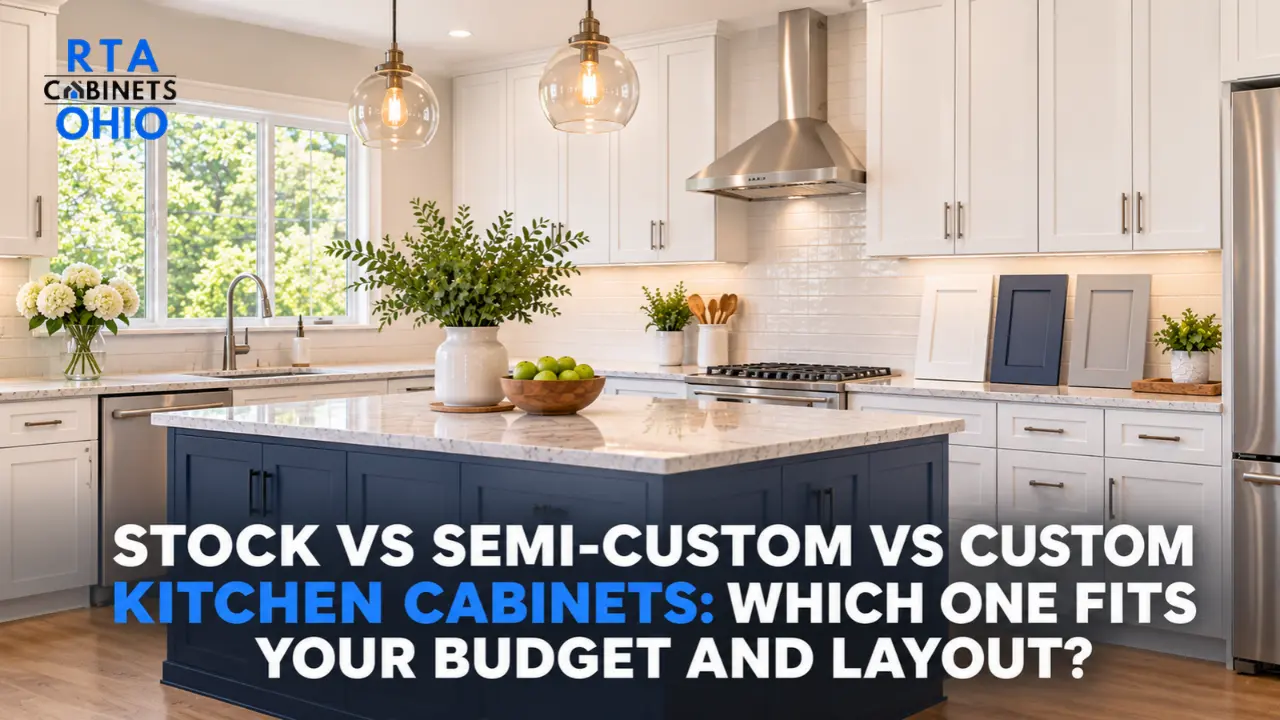
Stock cabinets are the lowest-cost, fastest option and work well in square, standard kitchens. Semi-custom cabinets add size, finish, and storage choices at a mid-range price, and often suit older layouts well. Custom cabinets are built to your exact room and cost the most. If you plan to buy kitchen cabinets Cleveland has plenty of options for, match the tier to your budget, your layout, and your timeline.
Cabinets are usually the biggest line in a kitchen remodel. Cost guides put them at roughly 35 to 50 percent of a typical project.
Cabinets commonly take 35 to 50 percent of a kitchen remodel budget, so the tier you pick shapes every other choice.
Let’s walk through all three, then match them to a real Northeast Ohio kitchen.
Stock cabinets are made in standard sizes and a short list of finishes. The maker builds them ahead of time, so they ship or load up quickly.
Stock boxes come in a fixed set of widths. Heights and depths are fixed too. If your wall is 62 inches wide, you fill the gap with filler strips.
Door styles are limited. You may see 5 to 10 choices. Many stock lines focus on white, gray, and a few wood tones.
Stock cabinets win on speed and cost. Many are ready to ship or pick up right away. Installation is also simple because the shapes are predictable.
The tradeoff is fit. In a kitchen with odd walls, filler strips add up. Box materials vary a lot by line, so you need to ask what the box is made of.
Semi-custom cabinets start from a stock-style catalog, then let you change key details. They are built after you order. That one fact explains both their flexibility and their longer lead time.
Semi-custom lines usually offer width steps of 3 inches and wall cabinet heights beyond the standard 30 and 36 inches. You can pick a 33 or 42 inch wall cabinet to match your ceiling.
You also choose from many more door styles and finishes. Interior storage upgrades like pull-outs, tray dividers, and spice racks are common add-ons.
Because each order is built to spec, expect about four to eight weeks. Some guides list six to twelve weeks for certain lines. Upgrades can stretch that further.
Cost sits in the middle. Price guides place semi-custom around $150 to $700 per linear foot, depending on the line and options.
Custom cabinets are designed and built for one room. A cabinet maker takes your measurements and builds every box, door, and trim piece to fit.
Custom work handles curved walls, odd angles, and built-ins. It also allows unusual dimensions and special materials. If you need a cabinet 19 and 5/8 inches wide, a custom shop can build it.
That freedom is the main reason people choose this tier. It is also why custom projects take longer to design and approve.
Custom cabinets often run about $500 to $1,200 per linear foot. Lead times commonly run ten to sixteen weeks or longer, and some guides cite eight to twelve weeks for the manufacturing and delivery stage alone.
If your remodel schedule is tight, that wait matters as much as the price.
Here is how the three tiers line up on the points that decide most projects.
Price per linear foot. Stock sits at the low end. Semi-custom sits in the middle. Custom sits at the top.
Sizing. Stock uses fixed sizes. Semi-custom adjusts in set steps. Custom adjusts to any dimension.
Door styles. Stock offers a short list. Semi-custom offers dozens. Custom offers nearly unlimited choices.
Lead time. Stock can be near immediate. Semi-custom runs weeks. Custom runs the longest.
Typical fit. Stock suits simple, square kitchens. Semi-custom suits most remodels. Custom suits unusual rooms and high design goals.
Cost per linear foot is one of the clearest ways to compare tiers, and the ranges overlap more than most shoppers expect.
Notice the overlap. A high-end stock line can cost more than a basic semi-custom line. That is why you compare the construction, not just the label.
Numbers make the tiers easier to feel. A typical mid-sized kitchen has about 25 linear feet of cabinets, counting base and wall runs together.
Multiply that by the ranges above. Stock lands near $2,500 to $10,000. Semi-custom lands near $3,750 to $17,500. Custom lands near $12,500 to $30,000.
This is simple arithmetic on published ranges, not a quote. Real prices depend on the line, the finish, and the extras you add. Still, the pattern is clear. The low end of semi-custom can sit close to the high end of stock. The low end of custom sits above the entire stock range.
That overlap is your negotiating room. Ask for itemized prices on the same layout from two or three tiers, then compare them line by line.
The tier sets the range. Features move you up or down within it.
Flat slab doors and simple five-piece Shaker doors cost less than raised panels, glass inserts, or glazed finishes. Painted finishes usually cost more than basic stained ones because they take more steps to apply.
Pull-out trays, trash pull-outs, corner solutions, and roll-out shelves add cost per cabinet. They also change how the kitchen works every day. Pick two or three that solve a real problem, such as a deep corner or a crowded pot drawer.
Crown molding, light rail, base molding, and end panels often sit outside the base price. Ask what a quote includes before you compare totals.
A short checklist keeps the decision grounded.
If you can answer all six, you are ready to compare real options.
Start with a number you can live with. Then work backward.
Measure each wall where cabinets will go. Add the runs together. Include islands. This total is your linear footage, and every price guide uses it.
A small galley kitchen may need only 15 to 20 linear feet. A large kitchen with an island can pass 40.
Take your total remodel budget and apply the 35 to 50 percent range. That gives you a rough cabinet ceiling. Then divide by your linear feet to see which tier is realistic.
If the result lands under $200 per linear foot, stock or a value semi-custom line is the likely match. If it lands above $500, custom becomes realistic.
Hardware, crown molding, fillers, toe kicks, and installation sit on top of the cabinet price. Many shoppers forget this and go over budget. Build a 10 to 15 percent buffer into your plan.
Budget is half the decision. The other half is the room.
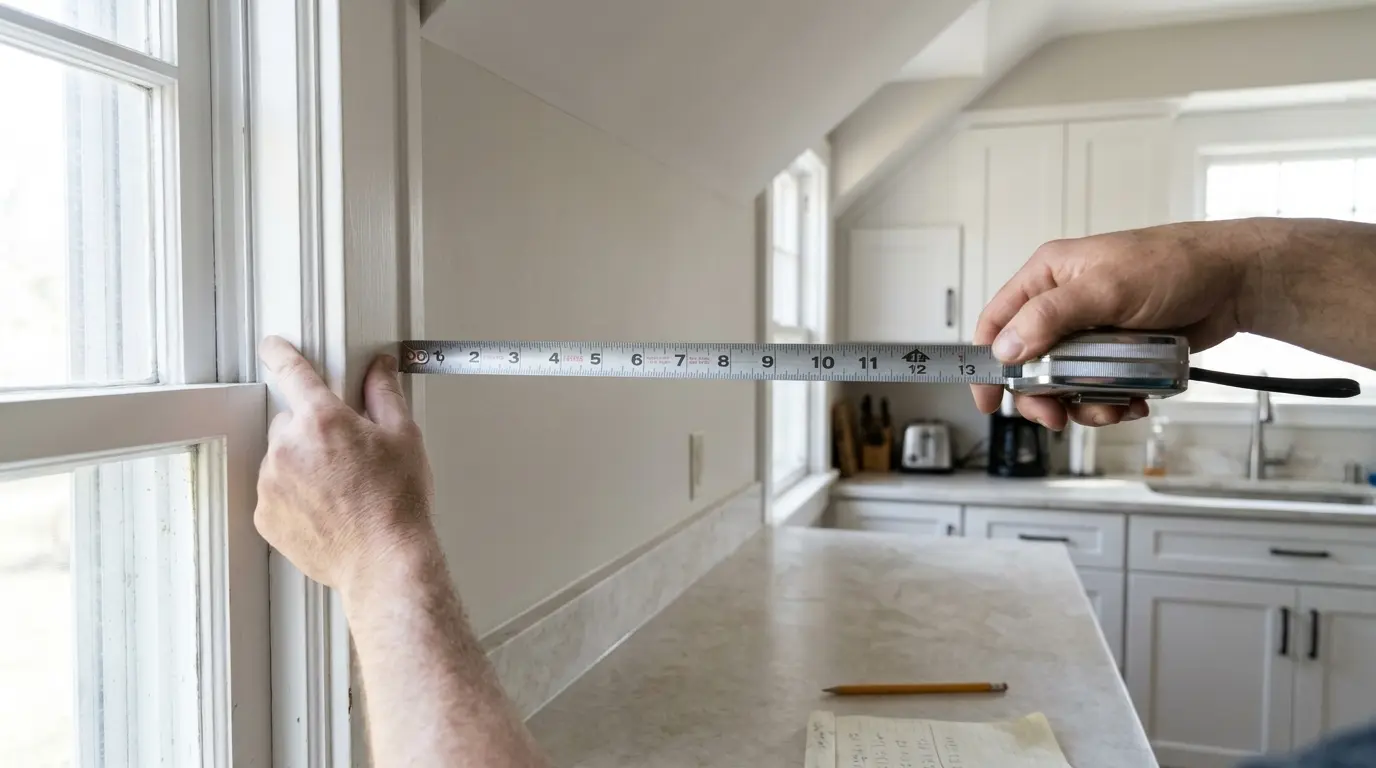
If your walls are straight and your openings are standard, stock cabinets often fit with few fillers. You gain speed and keep costs low.
Older homes are rarely square. Walls lean, ceilings slope, and window openings are not standard. That is where semi-custom sizing earns its price.
Lakewood is a good example. In Lakewood, the median home was built in 1938.
A kitchen built in the 1920s may have a chimney chase, a back-stair wall, or a window set off-center. Fitting stock boxes around those features means more filler strips. Semi-custom lets you adjust widths and heights to cut that waste.
Lakewood is known as the “City of Homes,” and many of those homes are doubles with compact kitchens. In a narrow galley kitchen, every inch counts. Shaving 3 inches off a cabinet width can free up a walkway.
Tall pantry cabinets also help when floor space is small. They move storage up the wall instead of out into the room.
Large islands and open plans need matching finishes across many cabinets. Semi-custom lines make color and door-style matching easier. Custom shops can build islands with seating, special panels, and built-in storage.
The tier name does not tell you how well a cabinet is built. A stock cabinet with a plywood box can outlast a poorly built semi-custom one. Ask these questions about any cabinet you consider.
Plywood resists swelling better than particleboard when moisture is present. Kitchens see steam, spills, and temperature swings every day. For a deeper look, read this guide on plywood and particleboard differences.
Look for dovetail or similar joined drawer boxes. Check for full-extension glides and soft-close hinges. These parts get used thousands of times a year.
A warranty tells you how much the maker expects the cabinet to last. Read what it covers and what it excludes. Ask whether it covers finish, hardware, and door warp.
Lead time often decides the winner when budgets are close.
Stock cabinets can be ready in days when the line is in inventory. Semi-custom usually takes four to eight weeks, and some lines run six to twelve. Custom often takes ten to sixteen weeks or more.
Add time for measuring, design approval, delivery, and installation. Plan your demolition date after your cabinet delivery date is confirmed, not before.
A few errors show up again and again. Knowing them saves money.
Two cabinets with the same price can have very different boxes, drawers, and finishes. Compare the build details first.
Filler strips look cheap on paper. In a kitchen with odd walls, they stack up and hurt the look. Ask how many fillers your layout will need.
A measurement error on a semi-custom or custom order is costly. Confirm measurements twice, and have the order checked against your design plan.
Northeast Ohio homes span a wide range, from century-old doubles to newer builds in the suburbs. Because of that range, a single tier rarely fits every room.
Before you buy kitchen cabinets Cleveland homeowners can ask one simple question: how many fillers will my walls need? If the answer is “a lot,” a tier with more sizing choice is worth a look. If the answer is “almost none,” a stock-style line may do the job at a lower cost.
You can also mix tiers. Some remodels use standard boxes along straight walls and one specially sized cabinet by the window or chimney chase.
RTA (Ready-to-Assemble) cabinets ship flat and go together at home. Pre-assembled cabinets arrive built. Both are delivery formats, not quality tiers.
An RTA line can be stock-style, with fixed sizes, or offer more options. What matters is the box material, the hardware, and the warranty. Do not assume that “ready-to-assemble” means lower quality, and do not assume that “custom” means better quality either.
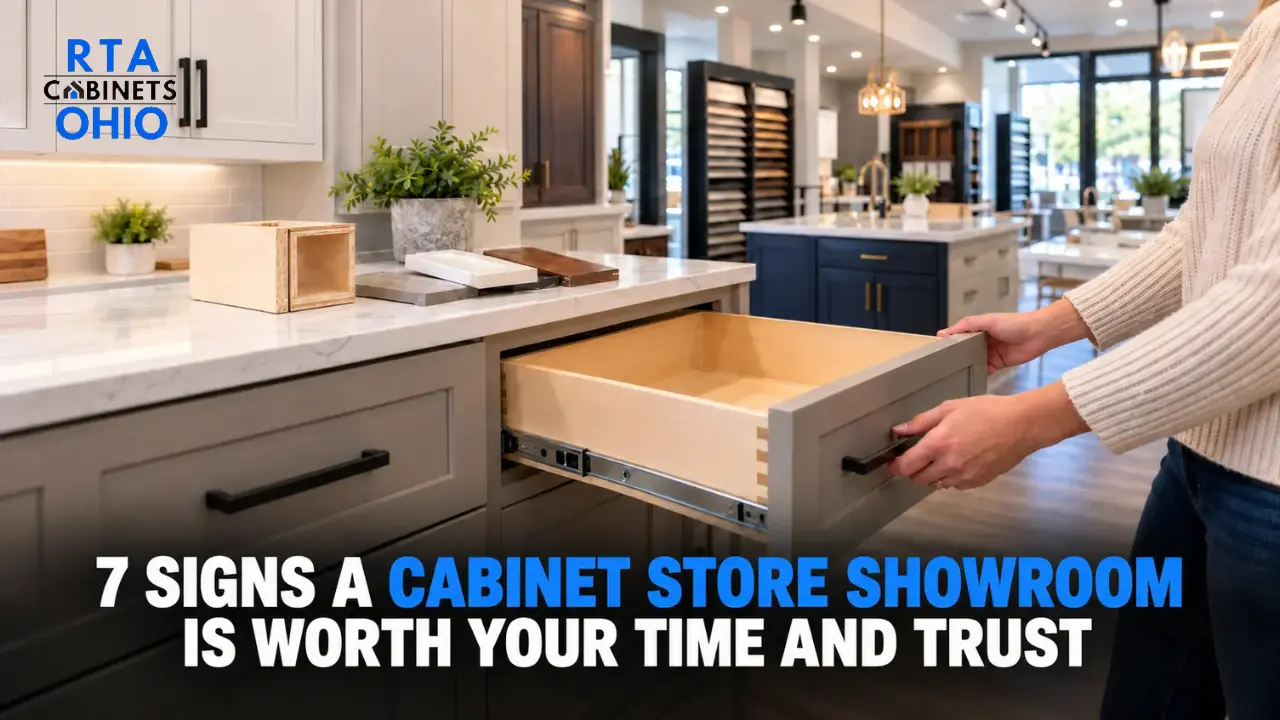
Photos hide a lot. Door thickness, finish depth, and drawer feel are easiest to judge by hand.
Lakewood homeowners are a short drive from several cabinet showrooms and warehouses across the Cleveland area. Bring photos of your kitchen and your measurements. Ask to open real doors and pull real drawers.
Check the box edges for plywood layers. Look inside the cabinet for a sealed finish. Ask how each door is attached and how far the drawers extend.
RTA Cabinets Ohio is a local cabinet warehouse at 4650 W 160th St #105, Cleveland, OH 44135. Homeowners in Lakewood, near Tuland Park at the crossing of Athens Ave and Brown Rd (41.473465, -81.794148), can reach the warehouse by car to compare real cabinet doors, finishes, and construction.
The team also helps Northeast Ohio homeowners with layout questions, so you can check your measurements against a design plan before you commit. See the full lineup on the buy kitchen cabinets page, or look at a full set of kitchen cabinets to compare a standard layout.
Buy Kitchen Cabinets Lakewood: Get Started Now
You can also open the business listing: buy kitchen cabinets Cleveland.
Stock, semi-custom, and custom cabinets each have a place. Stock keeps cost and wait time low. Semi-custom gives you sizing and finish choice. Custom solves unusual rooms and design goals.
Start with your linear feet and your budget range. Then check your layout for filler strips, uneven walls, and ceiling height. Compare the box, the drawers, the hinges, and the warranty, not just the label.
With that process, buying kitchen cabinets in Cleveland becomes a clear decision instead of a guess.
What is the difference between stock, semi-custom, and custom cabinets?
Stock cabinets come in fixed sizes and limited styles. Semi-custom cabinets let you adjust sizes, finishes, and storage within a catalog. Custom cabinets are built to your exact room and design.
Are semi-custom cabinets worth the extra cost over stock?
They can be if your kitchen has uneven walls, unusual ceiling heights, or needs specific storage. In a square, standard kitchen, stock cabinets often do the same job for less.
How long does it take to get kitchen cabinets after ordering?
Stock cabinets can be quick when they are in inventory. Semi-custom often takes four to eight weeks, and custom commonly takes ten to sixteen weeks or longer.
Where can I buy kitchen cabinets in Cleveland and see them in person?
You can visit local cabinet warehouses and showrooms across Northeast Ohio. Bring your measurements and photos so you can compare doors, finishes, and drawer construction by hand.
Should I buy kitchen cabinets before choosing countertops?
Most remodelers pick cabinets first, then order countertops after the cabinets are installed or the final layout is confirmed. Check with your countertop fabricator for their measuring timeline.