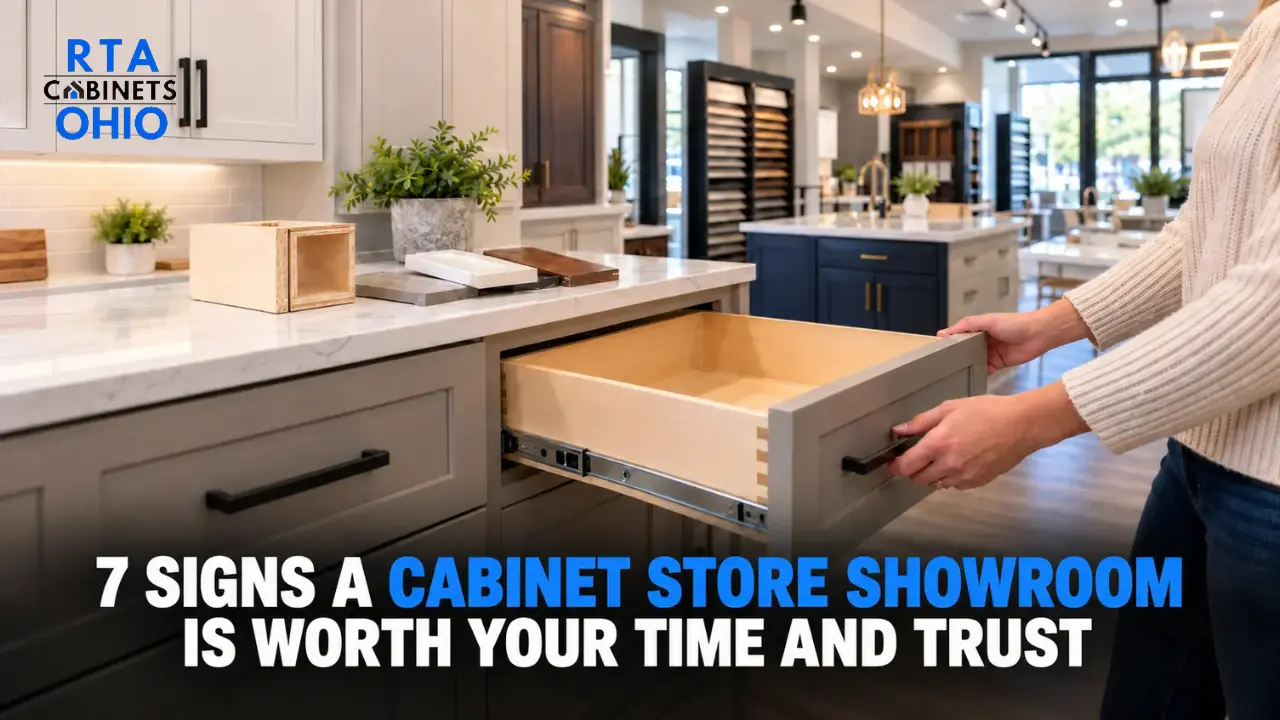
A cabinet showroom is worth your time when it lets you open full cabinets, explains what the boxes are made of, and puts pricing and warranty terms in writing. If a store dodges any of those, keep looking. Here are seven signs to check, in the order you will likely notice them as you walk in.
Cabinets are hard to undo. Once the boxes hang on your wall and the countertop sits on top, a mistake costs real money to fix.
A showroom visit is your cheapest chance to catch problems early. But only if the showroom shows you the truth. Some do. Some are built to look good and say very little.
That is why you need a simple way to tell the two apart. A good cabinet store welcomes your checks. A weak one gets nervous. The seven signs below give you a fair way to compare.
NKBA (National Kitchen and Bath Association) budget guidance puts cabinets at about 30 percent of a typical kitchen remodel, the largest single share.
On a $50,000 kitchen, that guidance works out to roughly $15,000 in cabinets. A wrong call here is not small.
An NKBA study of 2015 kitchen spending found that around two thirds of remodeling consumers visit a big box store, and most visit more than one type of store.
You will probably compare stores too. So use the same seven checks at every stop. It keeps the comparison fair.
Save it to your phone. Walk in with your kitchen measurements and a few photos of your space. Then score each store from zero to seven.
A store does not need a perfect score. But a store that misses three or more signs deserves a hard second look.
Each sign below tells you what to look for and what a warning looks like. Most checks take under a minute and cost nothing.
A good showroom has full cabinets on display. Not just small door samples on a board. You should be able to open a door, pull a drawer all the way out, and press on a shelf.
Look for a mix of base cabinets, wall cabinets, and a sink base. The sink base matters most. It shows how the store handles plumbing cutouts and moisture.
Also check whether the styles on the floor match the styles you are considering. A deep catalog is fine. But a picture on a screen is not a cabinet.
A door sample tells you color and door style. That is all it tells you. It says nothing about the box, the drawers, or the hardware.
If the store only has samples, ask where you can see a full cabinet. If the answer is “online” or “in the catalog,” the visit will not teach you much.
The box is the skeleton of the cabinet. Doors get the attention, but the box does the work. It holds your countertop, your dishes, and your sink.
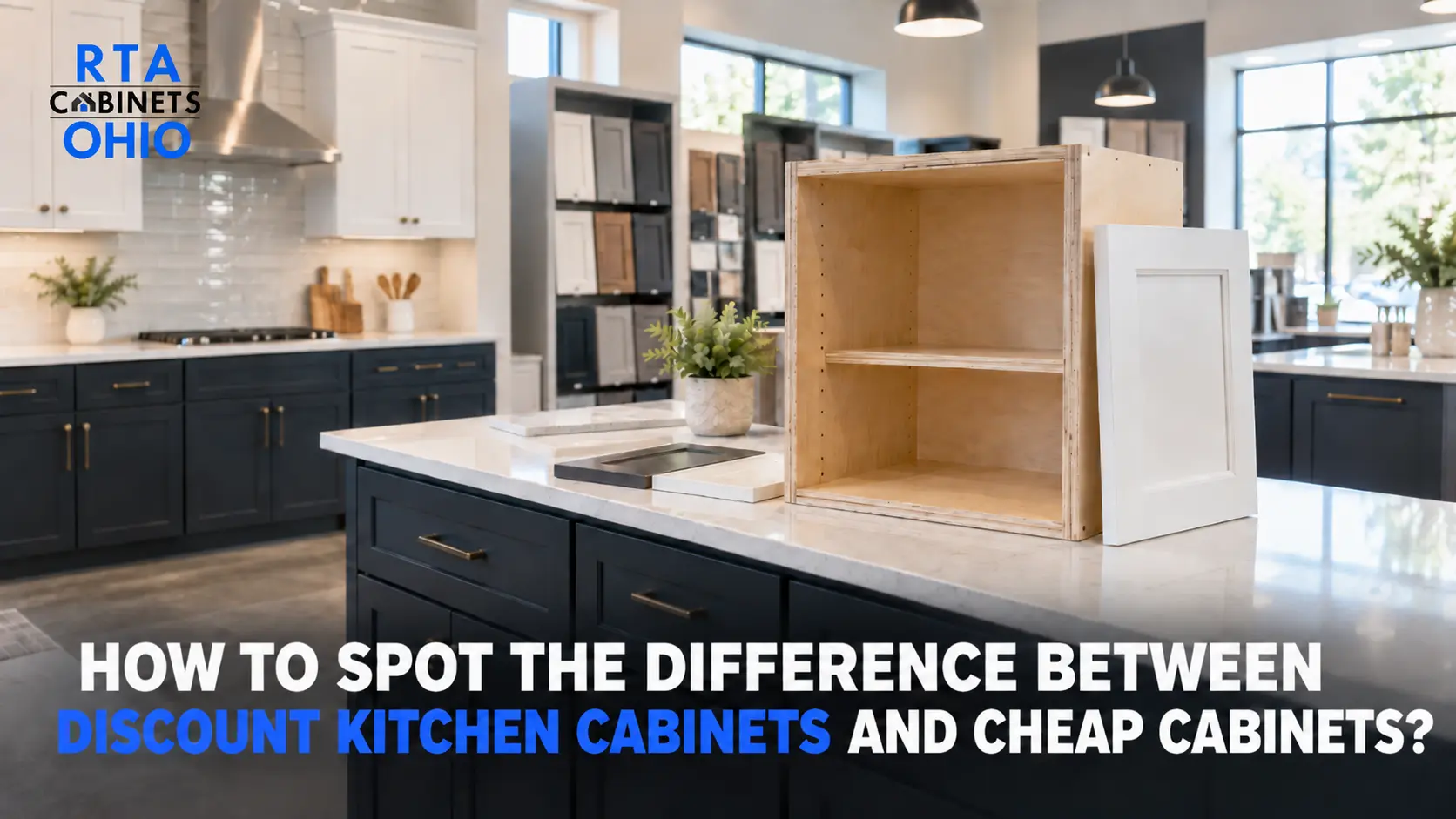
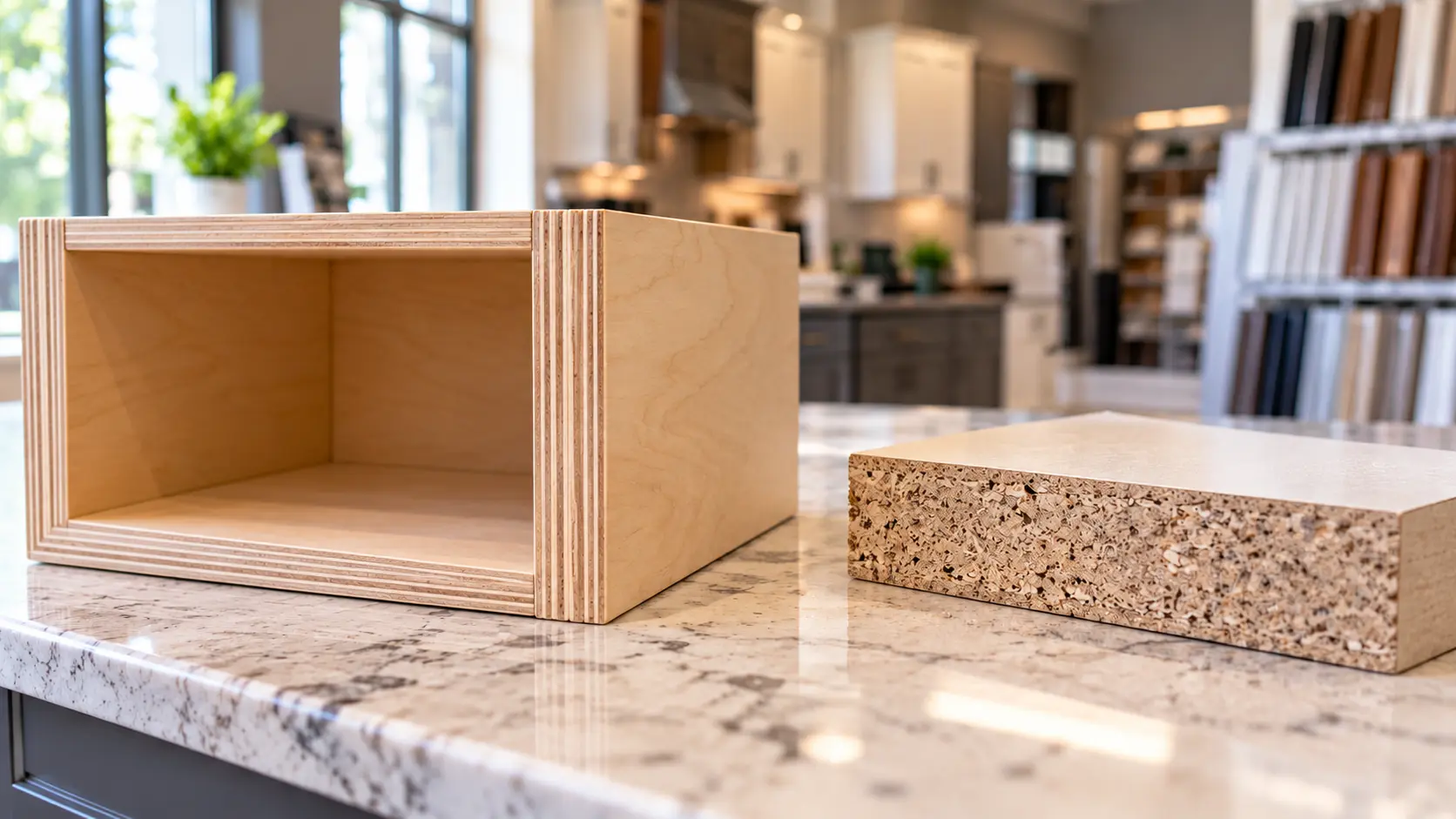
Ask to see an unfinished edge. A cut sample or the top of an unfinished panel works well. Plywood shows thin layers stacked like pages in a book. Particleboard looks like pressed sawdust and wood chips.
A confident store shows you this without hesitation. Many keep a cut sample on the counter for exactly this reason. If staff are unsure what the box is made of, treat that as an answer.
Check the back panel too. A thin back can be fine. One that flexes under your hand is not.
Particleboard swells when it gets wet. The sink base is the first place it fails, because a slow leak or daily splashes find the bottom panel first.
Plywood handles moisture better, though no cabinet box likes standing water. For a deeper look, read this guide on plywood versus particleboard differences that matter when buying cabinets.
Drawers get more use than any other part of a kitchen. They are also the first place weak construction shows up.
A drawer that feels flimsy in the showroom will not improve once you fill it with pots and plates.
Pull a drawer all the way out. Look at the corner where the side meets the front. Interlocking joints that look like small teeth are dovetails. They resist the pulling and loading that kitchen drawers face every day.
Stapled or glued butt joints tend to loosen over time. Press on the drawer side. It should feel rigid, not spongy.
Full-extension slides let the drawer open all the way, so you can reach the back. Slides that stop short leave dead space you cannot reach.
Soft-close hinges and slides stop slamming. They also protect the finish and the joints over years of use. Ask whether soft-close is standard or an upgrade. That answer changes the real price.
Open a door about halfway and let go. A good soft-close hinge catches it and pulls it shut quietly.
Do the same with a drawer. If it bounces, binds, or sticks, note it. You are testing the hardware you will live with every day.
Step back and look at a full run of cabinets. Do not judge one door at a time.
The gaps between doors and drawers are called reveals. Even reveals suggest a box built square and hardware set with care.
A common showroom guideline is that reveals should stay within about an eighth of an inch along a run of cabinets.
If gaps look wide, narrow, or uneven, ask why. Shipping can shift reveals slightly. A showroom that cares will have adjusted them.
Finish deserves a look too. Run your hand along an edge. It should feel smooth and even, with no rough patches or drips. Check that color matches between doors, drawer fronts, and panels.
Bring a photo of your kitchen. Hold a finish sample next to it under the store’s lighting. Then step toward a window. Color changes with light. Better to learn that here than after installation.
Price talk is where many showrooms get slippery. A good one keeps it simple.
Honest stores share starting prices on the spot or post them. A store that will not say a number until you hand over your phone and email is playing a different game.
Ask for a written estimate. It should list:
If a store only gives a vague range, or says “it depends” with no next step, that is a sign.
Two quotes only compare if the cabinets match. Check the box material, drawer construction, hinge type, and sizes on each one. A lower total can hide a thinner box or a missing hardware line.
Ask each store the same questions. Write down the answers. You will see the gaps fast.
A warranty tells you how long the maker expects the cabinet to last. Ask for the terms in writing before you order.
Ask these four questions:
Look for plain language. If the terms are buried, or staff cannot explain them, that is your answer.
A local store with its own warehouse can often swap a damaged piece fast. A claim that must travel to a distant factory usually takes longer. Worth asking before you pay.
Cabinets rarely arrive the day you order them. Most arrive in weeks. A trustworthy store tells you the real timeline up front.
Some stores keep popular styles on hand for same-day pickup. Others order everything. Both models work. But the store should be clear about which is which.
Ask these three things:
Get the answers in writing, with an order date.
Be careful with a store that promises quick delivery on everything. Lead times depend on the style and the maker. Honest answers sound specific, such as “this style, about one to two weeks.” Vague answers sound like “soon.”
The seven signs cover the product and the paperwork. One more thing is worth watching: the people.
Good staff answer plainly. They say “I don’t know, let me check” when they are unsure. They do not rush you or push a same-day decision.
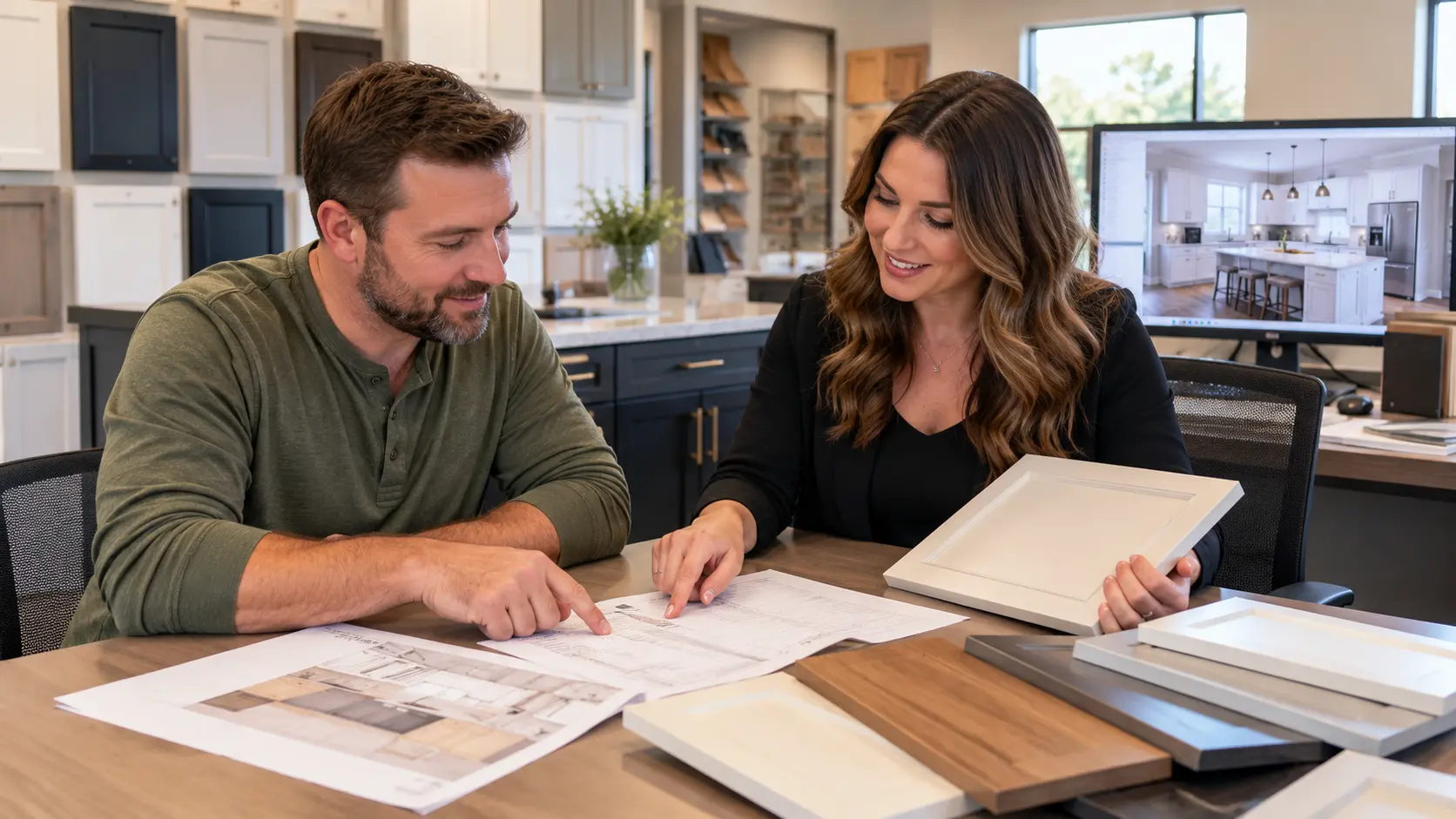
A free in-person design session is a good sign when it comes with no pressure. A designer who works from your measurements and photos can catch layout mistakes before you order. That help is worth more when it is offered without strings.
Notice how staff react when you open a drawer or ask about the box. Calm and curious is good. Defensive is not.
If you are searching for a cabinet store near Parma, plan one focused visit instead of several loose ones. Homeowners in Parma Heights have plenty of options around Snow Rd and Ridge Rd, so a clear plan saves time.
Bring these items:
A designer can only guide what they can see.
Then run all seven checks on one trip. Open drawers. Check an edge. Ask for a written estimate. Read the warranty. Ask about timing. That is a full afternoon of useful answers.
If you are comparing Parma kitchen cabinets across several stores, take the same notes at each one. Look at Parma kitchen cabinets side by side, and trust the notes, not the sales pitch.
Even careful shoppers slip. Here are the mistakes that come up most.
Doors are the part everyone notices. But the box, drawers, and hinges decide how the kitchen holds up. Look past the paint.
Walking in without measurements means a rough estimate at most. You may order twice, or reorder pieces that do not fit.
A showroom visit is for gathering facts. You do not have to order that day. A store worth your trust lets you go home and think.
Memory fades fast after your second or third showroom. Write your scores down in the car, before you drive to the next stop.
Give each store one point for every sign it passed. Then add a short note on how staff made you feel. A store that scores five or more out of seven is a strong candidate. A store at three or below needs a very good reason to stay on your list.
Use one page per store. List the store name, the date, and the seven signs. Add the quote total, the warranty length, and the lead time.
Side by side, those pages make the choice clearer. You stop comparing feelings and start comparing facts.
Compare the written estimate with what staff told you out loud. Match the style name, the box material, and the hardware line by line. If a detail changed between the conversation and the paper, ask about it before you pay a deposit.
Some of the most useful questions feel awkward to ask. Ask them anyway. A fair store expects them.
Cabinets get bumped in transit. Ask who inspects the delivery, how long you have to report a problem, and who pays to replace a damaged panel. Clear answers here prevent long arguments later.
Plans shift once a contractor opens the walls. Ask whether you can add, swap, or remove a piece after you order, and what that costs. A store that has handled many remodels will have a plain answer ready.
A finish sample on your own counter, under your own lights, tells you more than ten minutes in a showroom. Ask to borrow one for a day or two. Stores that trust their finish usually say yes.
If you see these, slow down:
One red flag may be a bad day. Two or more is a pattern.
A showroom earns your time when it shows real cabinets, names its materials, and puts price and warranty in writing. The seven signs give you a way to check without guessing.
Start with the box and the drawers. Then ask for numbers. Then ask about timing. A store that passes most of these checks is worth your trust. A store that does not, is not.
Take your time with the comparison. The checks are quick, but the decision lasts for years. Walk in with your measurements, run the seven checks, and write down what you see. Then let the notes decide, not the sales pitch.
Cabinets take roughly a third of a kitchen budget. A few hours of checking is a small price to pay for getting it right.
Homeowners near the SW Italian/American Club, close to Snow Rd and Ridge Rd, are a short drive from the RTA Cabinets Ohio warehouse in Cleveland. Parma Heights sits near the coordinates 41.4050425, -81.7360562, so a trip to see real cabinets is an easy afternoon.
Get cabinet store near Parma Heights services now.
How do I know if a cabinet store is reputable?
Look for full display cabinets, staff who can name the box material, written pricing, and clear warranty terms. A reputable store answers these without hesitation.
What should I look for when visiting a cabinet showroom?
Check the cabinet box edge, the drawer corners, the hinges, the reveals, and the finish. Then ask for a written estimate and the warranty terms.
Is it worth visiting a cabinet store near Parma before ordering online?
For most kitchens, yes. Color, finish, and drawer quality are hard to judge from photos. A short visit can prevent a costly return.
How can you tell if cabinets are plywood or particleboard?
Look at an unfinished edge. Plywood shows thin stacked layers. Particleboard looks like pressed wood chips with no layers.
What warranty questions should I ask a cabinet store?
Ask how many years it runs, what parts it covers, who handles claims, and whether returns carry a restocking fee. Get every answer in writing.