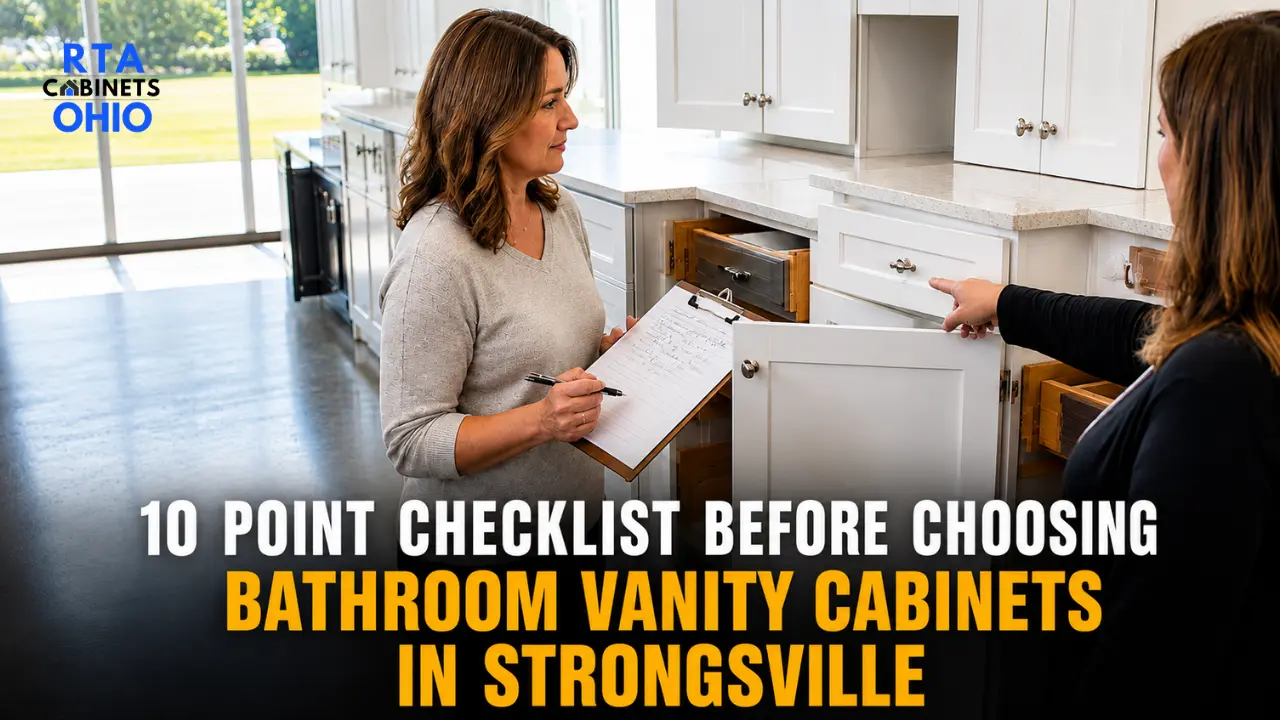
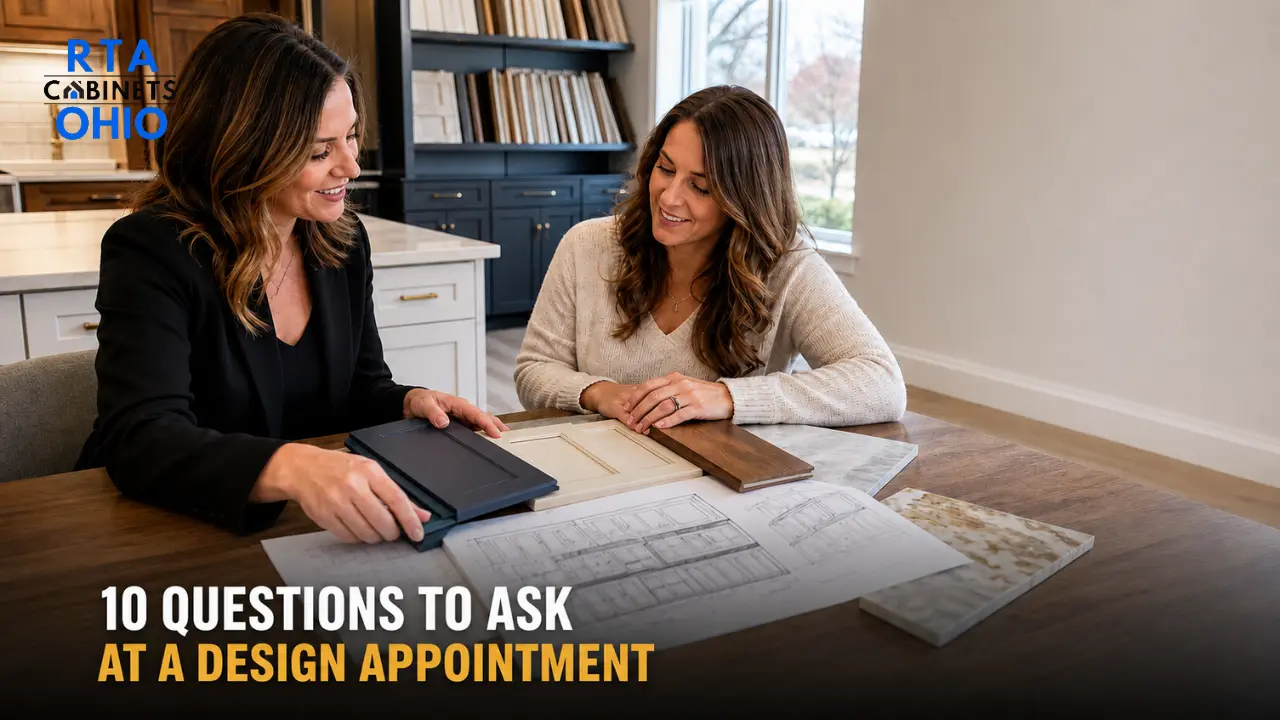
A design appointment for pre assembled kitchen cabinets in Strongsville works best when the homeowner walks in with questions, not just a Pinterest board. These 10 questions cover material, hardware, layout, timing, and pricing, the details that decide whether the finished kitchen actually matches what was promised.
Why These Questions Matter Before You Order
A design appointment is the one point in the process where a question costs nothing and a missed detail can cost weeks. Once pre assembled kitchen cabinets ship, changing the material, the hardware, or the layout means a reorder, not a quick fix.
Most homeowners walk into a design appointment focused on color and door style. Those choices matter, but they are also the easiest to get right. The questions below cover what is harder to spot and more expensive to fix later.
RTA Cabinets Ohio has earned more than 100 five-star Google reviews from Northeast Ohio homeowners.
Cabinet boxes are typically built from plywood, particleboard, or in some cases solid wood face frames over an engineered box. Each performs differently under moisture, weight, and years of daily use around a sink or dishwasher.
Ask the designer directly which material is used in the box itself, not just the door front. Premium all-plywood construction holds up better around moisture and resists warping over time, which matters most in base cabinets near water sources.
The difference is easiest to feel, not just see. A plywood cabinet side generally feels denser and more rigid when tapped lightly. Particleboard tends to feel a bit softer and can show visible swelling along an edge after years near a sink, even when the surface finish still looks intact. If a showroom has cutaway samples of both, ask to compare them side by side before deciding.
Screw-holding strength is another practical difference worth asking about, especially for anyone planning to hang heavier upper cabinets or add shelving hardware later. Plywood generally holds screws more securely over repeated use than particleboard, which matters more than it might seem once cabinets have been opened and closed thousands of times over several years.
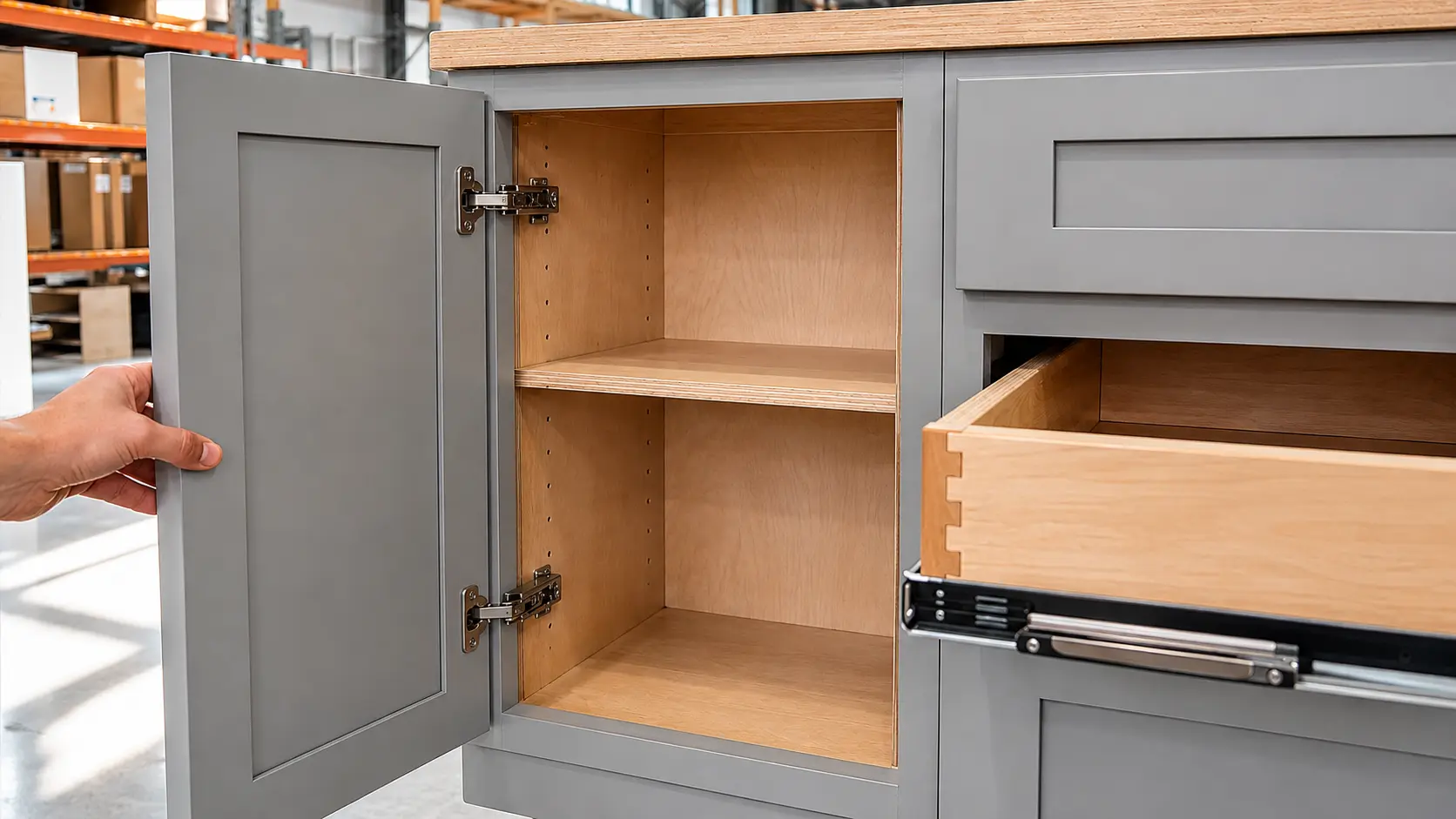
Hinges and drawer slides get used hundreds of times a year. Soft-close hardware costs more upfront but avoids the slammed-door wear that shortens a cabinet’s life.
Ask whether soft-close hinges and drawer slides are included standard or offered as an upgrade. This single detail affects how the kitchen feels every single day it is used.
Ask to open and close a display cabinet during the appointment itself. A soft-close hinge should ease shut on its own from a few inches away, without a hard stop. If a showroom display does not do that, ask what is different about the cabinets actually being ordered.
Question 3: Is My Layout Using Stock Sizes or Will It Need Fillers?
Stock cabinet widths increase in fixed increments, usually every 3 inches. A wall rarely lines up perfectly with those increments, which means most kitchens need at least one filler panel somewhere in the run.
Ask the designer to walk through the layout and point out exactly where fillers, end panels, or scribe pieces will be needed. A layout drawing that shows this clearly is worth far more than a verbal assurance that “it will fit.”
The cabinet boxes get most of the attention, but toe kicks, crown molding, filler panels, and end panels are what make a finished kitchen look complete rather than half done.
Ask for an itemized list before the order is finalized, not a summary. Confirm every finishing piece the layout requires is on that list, since a missing piece after delivery means another 1 to 2 week wait on non-stock styles.
Appliance clearance requirements come from the manufacturer, not from a general rule of thumb. Refrigerators need side clearance for door swing and airflow. Range hoods need a specific distance above the cooktop. Dishwashers need an exact opening width.
Bring the model numbers or spec sheets for every major appliance to the appointment, including any planned upgrades. A designer working from real specs can catch a clearance problem on paper instead of during install.
This question matters even more when upgrading appliances alongside pre assembled kitchen cabinets in Strongsville. A new refrigerator model is often a different width or depth than the one it replaces, and a layout built around the old appliance’s footprint will not necessarily fit the new one. If the appliance choice is not finalized yet, ask the designer how much flexibility the layout can absorb before it needs to be locked in.
Delivery timing depends entirely on the style chosen. White Shaker ships same-day from stock. Every other style ships in 1 to 2 weeks.
Ask specifically about the style being considered, not delivery timing in general. This single question often changes which finish a homeowner ends up choosing, especially on a tight renovation schedule.
On-site cabinet installation for a full kitchen commonly takes 2 to 5 working days once the room is ready to receive cabinets. That number does not include demolition, floor prep, or the final walkthrough.
RTA Cabinets Ohio backs every cabinet with a 6-year warranty on premium all-plywood construction.
Cabinet install rarely happens in isolation. It usually sits between demolition and countertop templating, so ask the designer how the cabinet timeline is expected to line up with the rest of the project, not just the cabinet portion alone.
Question 8: How Many Revisions Are Included in the Design?
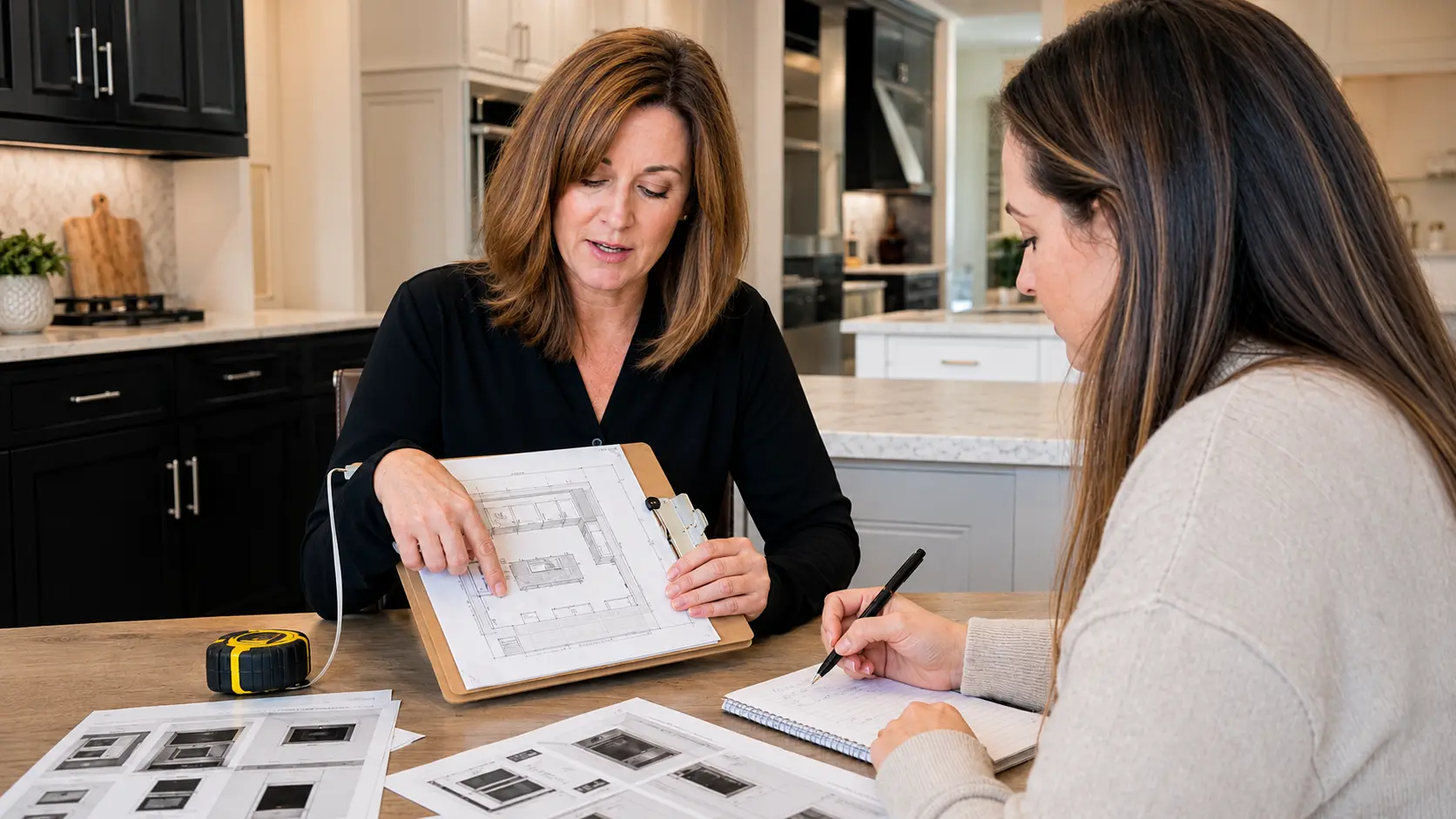
A first layout is rarely the final one. Ask upfront how many design revisions are included before additional changes cost extra, and how those revisions are communicated, by phone, email, or an updated drawing.
Knowing this ahead of time avoids an awkward conversation later, when a small layout tweak turns into an unexpected charge.
Even a careful design appointment cannot catch everything, especially in a Northeast Ohio home where walls and floors have settled over decades. Ask what the process looks like if a piece needs to be reordered: who covers the cost, how long a replacement takes, and whether a rush option exists for a stalled install.
Homes in Westwood Farms and across Strongsville range from newer construction to homes several decades old, and older framing makes this question worth asking regardless of how carefully the initial measurements were taken.
Ask specifically whether the design appointment itself includes a written layout the installer will follow, or whether measurements get re-verified on install day. A written layout gives both sides something concrete to check against if a piece does not fit as expected, rather than relying on memory or a verbal understanding from weeks earlier. It also makes any reorder conversation faster, since the designer can see exactly what was planned versus what the room actually needed.
Pricing hidden behind vague quote forms or presented only after multiple follow-up calls is a red flag. Ask for real numbers during the appointment itself, tied to the actual layout being discussed, not a rough estimate that changes later.
A free in-person design appointment in Strongsville should end with a clear, honest price for the exact cabinets and finishing pieces discussed, not a promise to follow up with a number.
Before the appointment, gather this: exact wall measurements from three points on every relevant wall, appliance model numbers or spec sheets, a rough idea of finish and door style preferences, and this list of 10 questions. This mirrors the same kind of preparation that helps first-time remodelers avoid the most common early mistakes.
A free in-person design walkthrough at RTA Cabinets Ohio typically takes about 20 minutes to cover a full kitchen layout.
Coming prepared with these questions turns a routine appointment into a genuinely useful planning session, and it is the same approach that has helped RTA Cabinets Ohio complete pre assembled kitchen cabinets projects across Strongsville and the rest of Northeast Ohio without the surprises that stall a remodel.
Westwood Farms sits near the intersection of Royalton Rd and Prospect Rd, close to Camden Woods, at approximately 41.3149944 latitude and -81.8563824 longitude. Homeowners across this part of Strongsville can bring their questions straight to the Cleveland warehouse for a full design review.
Get Pre Assembled Kitchen Cabinets Westwood Farms Services Now
What should I bring to a kitchen cabinet design appointment? Bring exact wall measurements from at least three points per wall, appliance model numbers, and a written list of questions covering material, hardware, timing, and pricing.
How long does a design appointment usually take? A free in-person design walkthrough covering a full kitchen layout typically takes about 20 minutes, though a more complex layout can take longer.
Should I ask about cabinet material even if I already like the color? Yes. Door color and cabinet box material are separate decisions. A cabinet can look identical on the outside while being built from very different materials underneath.
What is the difference between plywood and particleboard cabinet boxes? Plywood generally resists moisture and holds hardware more securely over years of use. Particleboard, sometimes called MDF, is lighter and more affordable but can be more prone to swelling near water sources.
Is pricing usually available at the design appointment itself? It should be. A straightforward design appointment ends with real pricing tied to the specific layout discussed, not a vague estimate that requires a follow-up call.