

Ordering pre assembled kitchen cabinets goes wrong in the same 8 places for almost every homeowner. Wrong measurements, missing filler panels, and mismatched finish quantities cause most of the delays. This guide walks through each mistake and how to avoid it before the order ships.
Pre assembled kitchen cabinets ship as finished boxes, not raw flat-pack parts. That is the whole appeal. It also means a wrong measurement or a missing piece cannot be fixed on the spot with a saw and a shim.
A wrong order usually means a wait for replacement parts. For non-stock styles, that wait runs 1 to 2 weeks on top of whatever delay already happened. For a family living without a working kitchen, that adds up fast.
Most of these mistakes are avoidable. They come from skipping steps, not from bad luck.
Older housing makes a few of these mistakes more common than in newer subdivisions. Older framing and older floors mean measurements matter even more than usual.
Many kitchens being remodeled today in homes from the 1970s and 1980s are working with 40 to 50 year old framing.
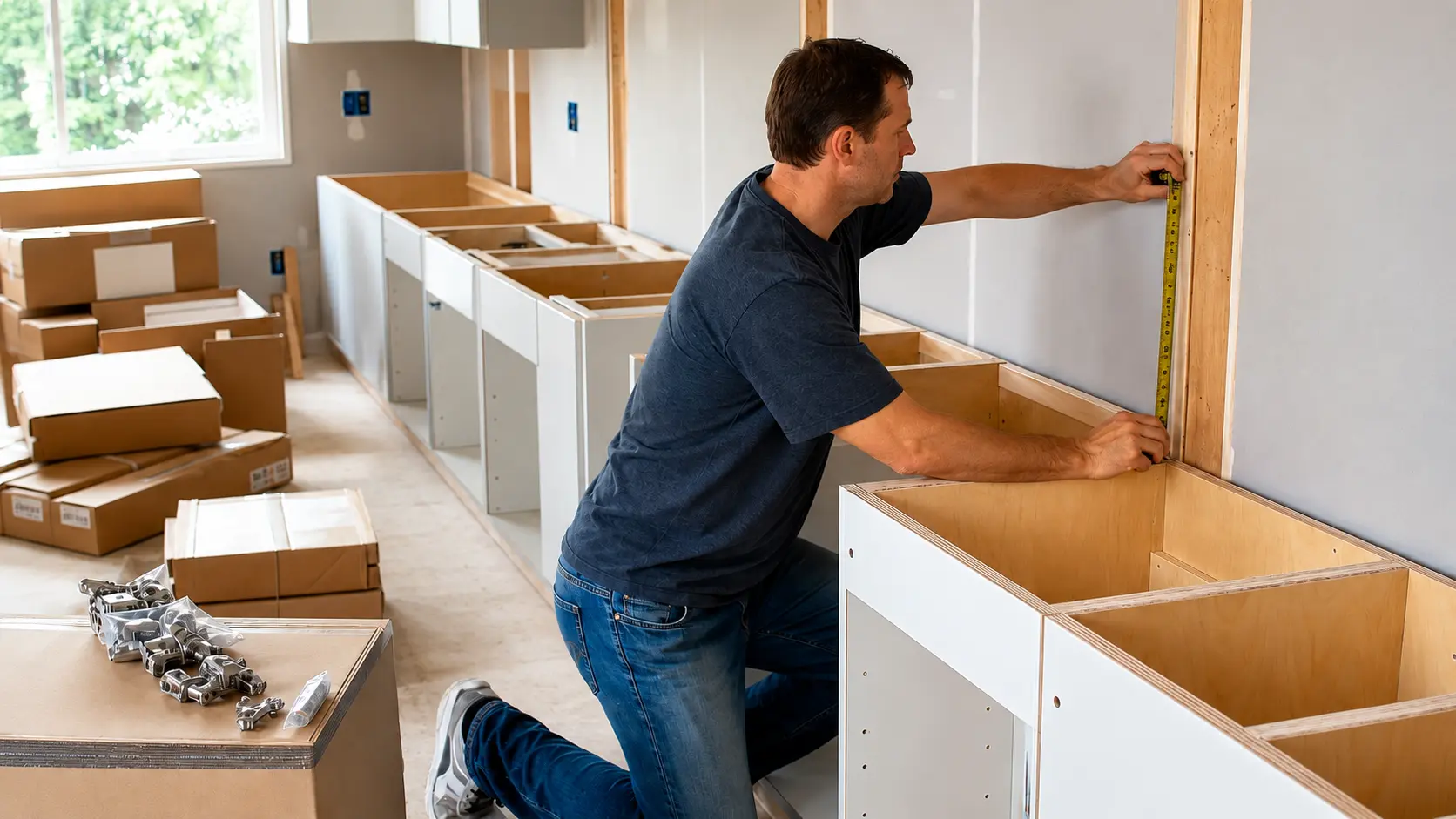
The single biggest cause of cabinet reorders is a wall measurement that looked close enough. Cabinets do not adjust once they are built. A quarter inch gap can mean a visible seam. A quarter inch of overlap can mean a cabinet that will not sit flush.
Measure every wall in at least three places: near the floor, at the midpoint, and near the ceiling. Walls bow. Corners drift from square. A measurement taken once at eye level misses all of that.
Homes built in the 1970s and 1980s have settled for decades. Framing shifts, floors slope slightly, and corners that were once 90 degrees rarely still are. This is not a defect. It is just what happens to a house over 40 or 50 years.
That settling is exactly why a free in-person design walkthrough matters more in older neighborhoods than in brand new construction. A designer working from real wall measurements can plan for the gap before the cabinets ever ship, instead of discovering it during install.
Ceiling height matters just as much as wall width. Many older kitchens have ceilings that vary by half an inch or more from one end of the room to the other. Upper cabinets that are ordered to hang flush against the ceiling on one side may leave a visible gap on the other side if that variation is not measured and planned for ahead of time.
A laser level or a long straightedge catches most of these issues in a few minutes. Check the wall at the floor, at the midpoint, and near the ceiling on every wall the cabinets will touch, and check the ceiling line the same way before finalizing upper cabinet heights.
Cabinet boxes get most of the attention. Filler panels, end panels, and toe kicks are the pieces that actually make a run of cabinets look finished and fit the room.
Filler panels close the small gaps next to walls, appliances, and corners that stock cabinet widths cannot perfectly cover. End panels finish any exposed cabinet side that would otherwise show raw material. Toe kicks close the recessed space at the floor.
Skip any of these and the order looks incomplete on delivery day, even if every cabinet box itself is correct. A second shipment for finishing pieces adds another 1 to 2 week wait on non-stock styles.
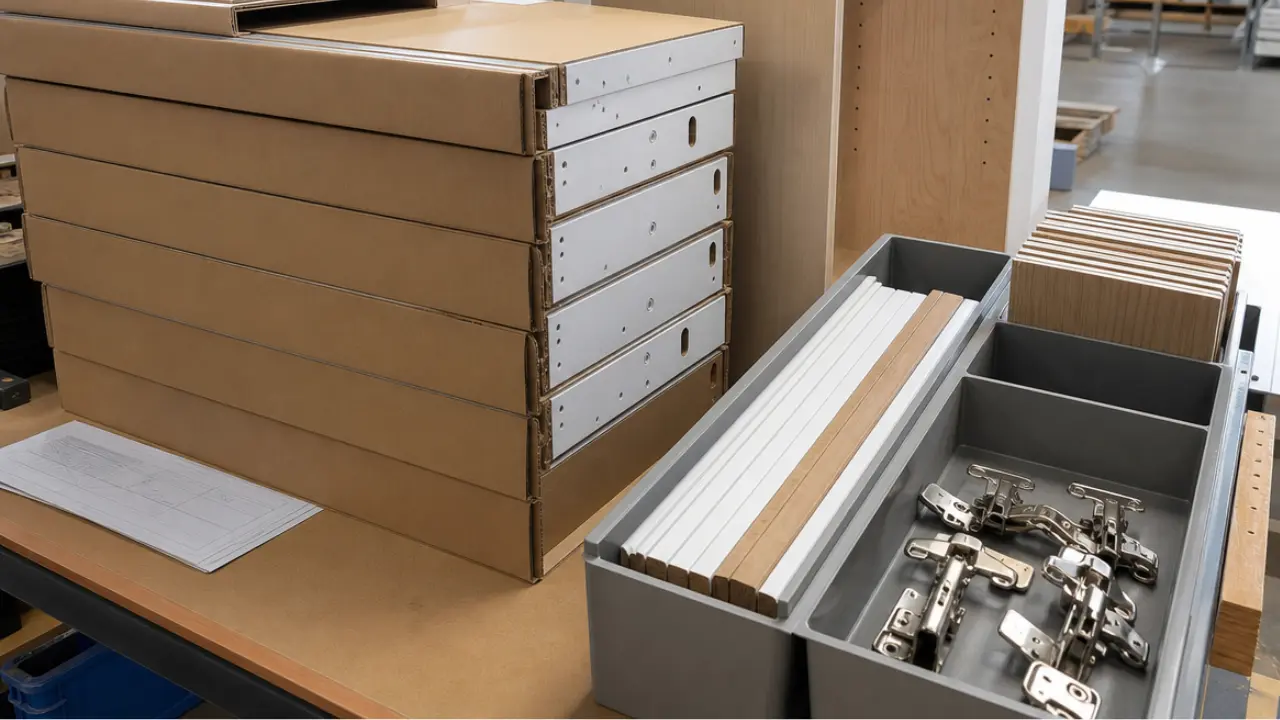
Stock cabinet widths increase in fixed increments, usually every 3 inches. A kitchen wall rarely lines up perfectly with those increments.
The mistake happens when a homeowner assumes the cabinet run will simply stretch or shrink to match the wall. It will not. The gap gets closed with a filler panel, a scribe piece, or a slightly adjusted layout, and all of that needs to be planned before ordering, not discovered during install.
A quick layout review during a free in-person design visit catches this every time. It takes minutes and prevents a mismatched run of cabinets from ever reaching the truck.
Every major appliance has a manufacturer-specified clearance requirement, not just a rough size. Refrigerators need side clearance for door swing and ventilation. Dishwashers need a specific opening width. Range hoods need clearance above the cooktop.
Order cabinets without checking these specs, and the appliance either will not fit or will not open fully once it does. This mistake is easy to avoid: pull the spec sheet for every appliance before finalizing the cabinet order, not after.
This becomes especially important when appliances are being upgraded as part of the same project. A refrigerator model swapped in during a remodel is often a different width or depth than the one it replaces, and a cabinet order finalized around the old appliance’s footprint will not necessarily fit the new one. Confirm every appliance model, including any planned upgrades, before the cabinet order is locked in.
Cabinet boxes are typically built from one of two materials: plywood or particleboard, sometimes called MDF. The two perform very differently under moisture, weight, and years of daily use.
Premium all-plywood construction holds up better around sinks, dishwashers, and high-traffic base cabinets. It is heavier and slightly more expensive, but it resists warping and holds screws and hinges more securely over time.
These are a few of the common cabinet and vanity mistakes homeowners make: the mistake is not choosing particleboard, but rather not knowing which material is being ordered and being surprised later by how the cabinets perform. Ask directly what the cabinet boxes are built from before placing the order.
A kitchen with two different cabinet runs, say uppers and a pantry wall, needs the exact same finish batch across both to avoid visible color variation. Ordering slightly different quantities of each style, or ordering from two different production runs, risks a mismatch that only becomes obvious once everything is installed side by side.
This is the same category of mistake homeowners make with bathroom vanities: underestimating how visible a small finish inconsistency becomes once cabinetry is installed and lit by daylight. Order slightly more than the minimum calculated need, and confirm all pieces ship from the same production batch.
Pre assembled kitchen cabinets are heavier and bulkier than flat-pack boxes. That affects three things: delivery scheduling, where the boxes get stored before install, and how much time the install itself takes.
On-site cabinet installation for a full kitchen commonly takes 2 to 5 working days once the room is ready to receive cabinets. That is the hands-on install time only. It does not include demolition, floor prep, or the final walkthrough.
On-site cabinet installation for a full kitchen typically takes 2 to 5 working days once the room is ready.
Add in that non-stock finishes ship in 1 to 2 weeks, and a realistic kitchen timeline needs to account for ordering time, delivery, a dry storage space for the boxes, and the install window itself. Underestimate any one of those and the whole project timeline slips.
Storage is the piece most homeowners forget entirely, especially when ordering pre assembled kitchen cabinets. A full kitchen order arrives as a stack of boxes that need a dry, level, indoor space to sit until the room is ready for them. A garage works in mild weather. A basement works year-round, as long as it stays dry. Cabinets left outside or in a damp space, even briefly, risk warping before they are ever installed. Plan the storage spot before delivery day arrives, not after the truck pulls up.
Even a careful homeowner reviewing their own measurements and cabinet list can miss something. A second review, from someone who reviews cabinet orders every day, catches mismatched quantities, missing finishing pieces, and layout gaps before they become a shipping problem.
This is exactly what a free in-person design walkthrough is for. It costs nothing, takes about 20 minutes at the kitchen cabinet showroom, and catches the kind of small errors that are expensive to fix after cabinets arrive.
Before placing an order for pre assembled kitchen cabinets, walk through this short list:
Measure every wall in three spots, not one. Confirm filler panels, end panels, and toe kicks are included in the order. Double check stock cabinet widths against the actual wall length. Pull appliance spec sheets for clearance and door swing. Confirm the cabinet box material, plywood or particleboard. Verify finish quantities cover the full kitchen from one production batch. Plan delivery, storage, and install time realistically. Get a second review of the full order before it ships.
RTA Cabinets Ohio has completed thousands of kitchen projects across Northeast Ohio, and the pattern behind most delays is almost always one of these 8 items.
RTA Cabinets Ohio has completed more than 8,000 kitchen and cabinet projects across Northeast Ohio.
Homeowners across Northeast Ohio can walk into the Cleveland warehouse with real measurements and walk out with a full pre-order review. You can also check our service areas.
Get pre assembled kitchen cabinets now
What is the most common mistake with pre assembled kitchen cabinets? Wrong wall measurements cause more reorders than any other mistake. Older homes in particular tend to have walls and floors that are slightly out of square after decades of settling.
Do I need filler panels with pre assembled cabinets? Most kitchens do, since stock cabinet widths rarely match a wall’s exact length. Filler panels, end panels, and toe kicks close those gaps and are easy to forget when placing an order.
How long does delivery take on pre assembled kitchen cabinets? White Shaker ships same-day from stock. All other styles ship in 1 to 2 weeks, so ordering timeline should account for that window plus install time.
Is plywood or particleboard better for kitchen cabinets? Premium all-plywood construction holds up better around moisture and daily wear than particleboard. Knowing which material is being ordered avoids a surprise later.
How can I avoid these ordering mistakes altogether? A free in-person design walkthrough reviews measurements, filler needs, finish quantities, and appliance clearances together before anything ships, catching most of these mistakes in one visit.