Small bathrooms have a way of making storage feel like an unsolvable puzzle. The toothbrushes, the hair dryer, the cleaning supplies, the extra towels, the medications, the skincare products, and the seemingly endless collection of items that accumulate in any household bathroom all need somewhere to live. And yet the room itself offers precious little space to work with. In a small bathroom, every square inch of storage capacity is valuable, and the vanity is the single most important element in determining how much of that capacity actually gets used effectively.
Ready-to-assemble bathroom vanities have changed the landscape of small bathroom storage significantly over the past decade. Understanding how these products are designed, how their construction translates into practical storage improvements, and how different configuration options address the specific challenges of small bathroom layouts gives homeowners a genuinely useful framework for thinking about their own bathroom storage situation. With thoughtful planning, even the smallest bathrooms can become far more functional than expected.
Before getting into how RTA vanities address the small bathroom storage problem, it helps to understand exactly what makes that problem so persistent and so difficult to solve with generic solutions. Recognizing these limitations allows for smarter design decisions from the start.
The small bathroom storage challenge is unique because of the combination of factors it presents simultaneously. The room is small, which limits the total surface area available for storage furniture. The items that need to be stored are extremely varied in size, shape, and use frequency, ranging from a large bottle of shampoo to a small pair of nail scissors. The room experiences high humidity and temperature variation, which limits the materials that can be used for storage effectively.
This combination of constraints is why small bathroom storage tends to fail in ways that storage in other small rooms does not. A small bedroom can get by with a clever wardrobe organization system. A small kitchen can gain considerable storage through vertical shelving and cabinet additions. But a small bathroom has plumbing fixtures occupying specific locations that cannot be moved, moisture that makes open shelving impractical for many items, and a floor plan that may leave room for little more than the toilet, the shower or tub, and the sink.
Clutter in a small bathroom is not just visually unpleasant. It creates genuine functional problems that make the room harder to use. Items stored on counter surfaces reduce the usable surface area for daily grooming tasks. Items stored in unstable arrangements get knocked over and broken. Medicines and personal care products stored without organization become difficult to find quickly, which matters more than it might seem in a room that most people use under time pressure in the morning.
The relationship between storage and hygiene is also relevant in bathrooms specifically. A cluttered bathroom is harder to clean thoroughly because items need to be moved to reach surfaces beneath them. Products stored in damp conditions without adequate airflow can develop mold or degrade more quickly than those stored in proper cabinetry with interior air circulation.
The term ready-to-assemble describes a construction and distribution approach rather than a quality level or a design style. Understanding what RTA means in practical terms helps clarify why these products represent a different kind of storage solution than the traditional assembled vanities that preceded them. It also highlights why they have become so widely adopted.
Traditional bathroom vanities are typically assembled at the factory and shipped as complete, finished units. This means the consumer receives a product that is ready to install but that offers little opportunity for customization in terms of dimensions, configuration, or internal organization features. The factory assembly approach also means the product takes up its full assembled volume during shipping, which affects what sizes and configurations can practically be offered through retail channels.
RTA vanities ship in flat-pack form, with all components cut, finished, and ready to be assembled by the installer. This flat-pack shipping approach allows manufacturers to offer a much wider range of sizes, configurations, and customization options than is practical with pre-assembled products.
The assembly process for RTA vanities uses various joining systems depending on the manufacturer and product line. Higher quality RTA products use dado and rabbet joinery for structural panels, dovetail joinery for drawer boxes, and mechanical fastening systems that create rigid and durable connections between components.
The practical storage advantage of RTA bathroom vanities Cleveland comes primarily from the customization possibilities that the RTA construction approach enables. Because components are produced and shipped separately rather than as a complete assembled unit, it is feasible to offer the consumer meaningful choices about how those components are configured, what internal features they include, and what dimensions they are built to.
This configurability is what allows RTA vanities to address the specific storage challenges of specific small bathroom layouts rather than offering a one-size-fits-all solution that fits few bathrooms optimally. A bathroom with an awkward wall configuration on one side, a door that swings into a certain zone, and a window positioned above the counter area has specific dimensional constraints that a configurable RTA vanity system can accommodate in ways that a fixed-size pre-assembled vanity cannot.
In small bathrooms, the most underused dimension is almost always vertical. Floor space is limited by the positions of the toilet, the shower or tub, and the door swing. But the wall space above the floor, particularly above the vanity itself, often goes completely unused except for a mirror. RTA vanity systems that incorporate vertical storage configurations change this equation significantly and unlock hidden storage potential.
A tall vanity configuration, where the cabinet extends significantly higher than the standard 32 to 36 inch vanity height, captures storage volume that standard vanities leave completely unused. The space from counter height to ceiling in a typical bathroom with 8-foot ceilings is approximately 4 to 4.5 feet, which is enough for several shelves of storage that can accommodate everything from towels and toiletries to cleaning supplies and medications.
The storage efficiency of a tall vanity configuration comes from the fact that it adds this vertical storage volume without requiring any additional floor footprint. A standard 24-inch wide, 36-inch tall vanity occupies 2 square feet of floor space. The same 24-inch wide cabinet extended to 84 inches tall occupies the same 2 square feet of floor space but provides more than twice the interior storage volume. In a small bathroom where floor space is the limiting resource, this vertical multiplication of storage capacity is genuinely valuable.
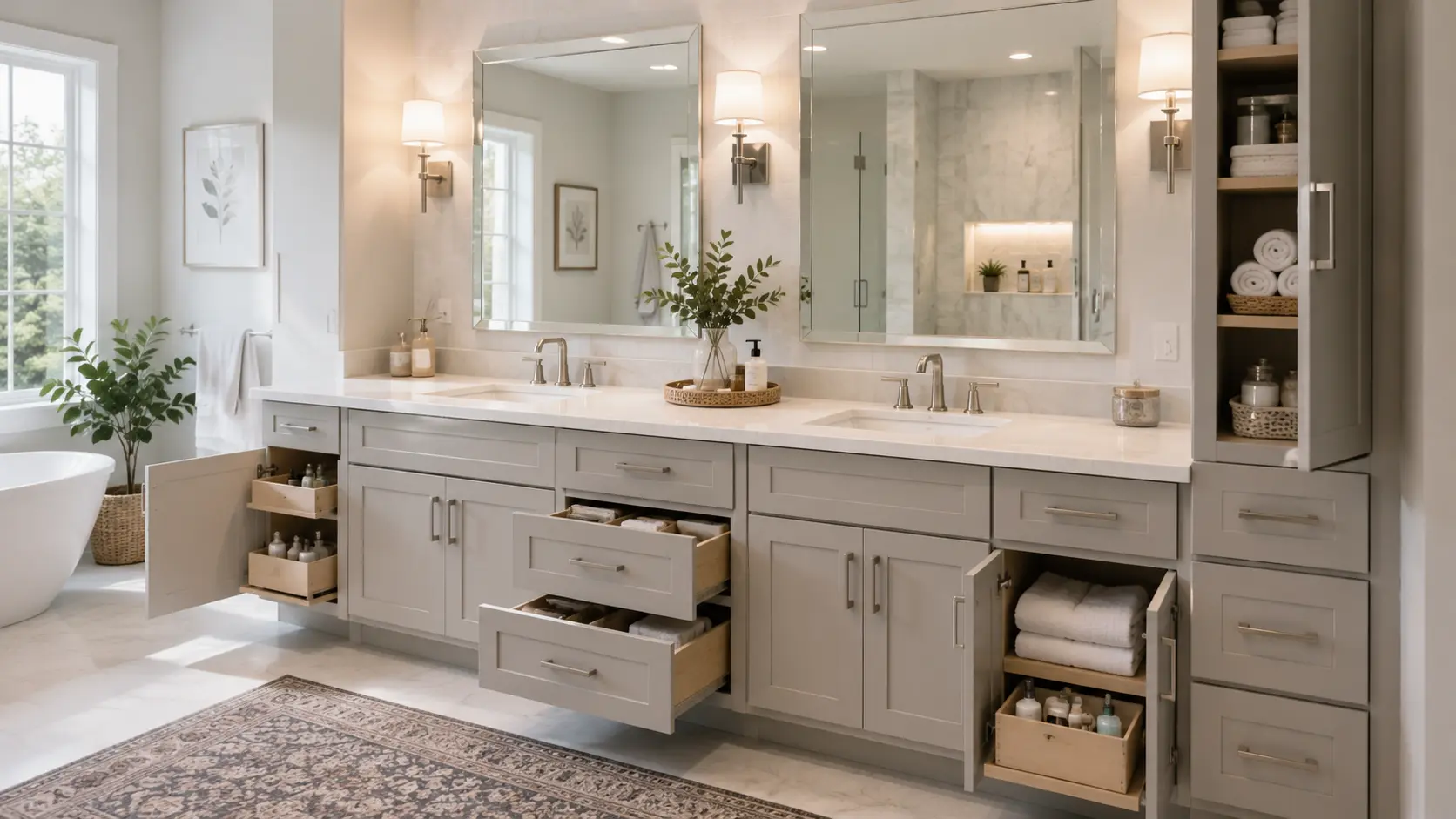
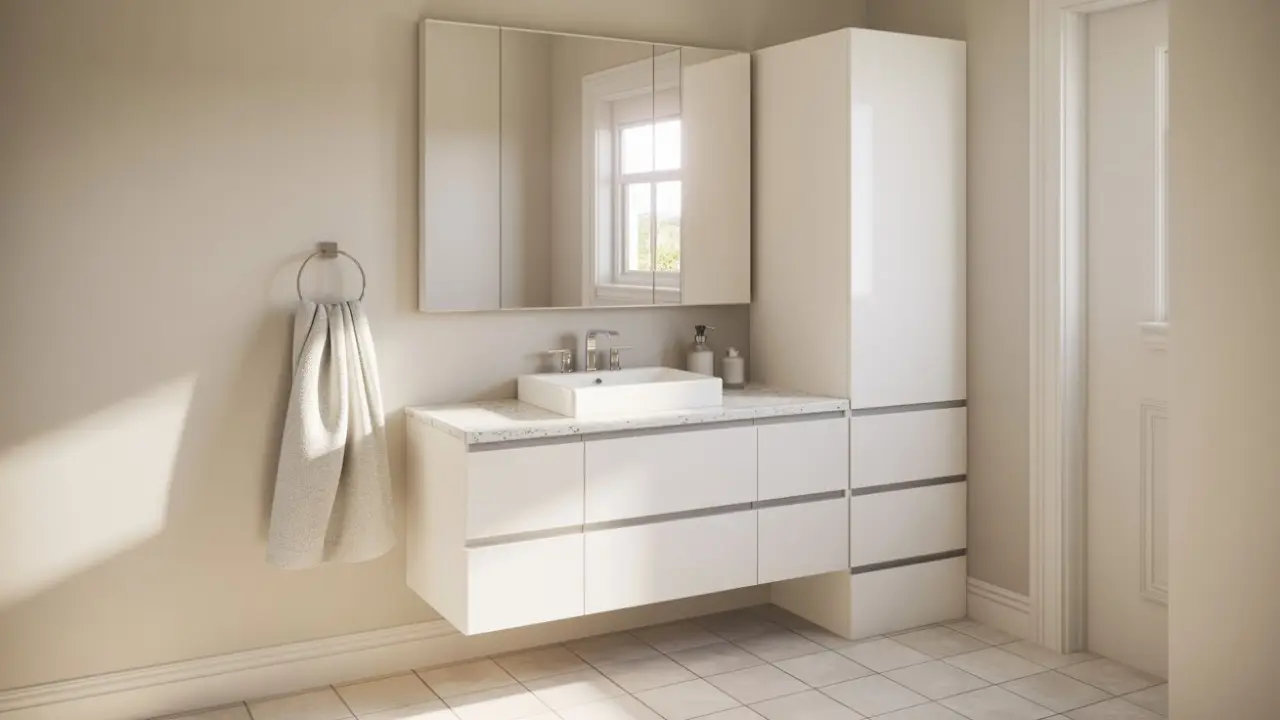
Many RTA bathroom vanity systems include matching tower cabinet units designed to be installed adjacent to the main vanity. These towers, typically 12 to 18 inches deep and 12 to 18 inches wide, extend from floor to ceiling and provide columnar storage that uses the vertical dimension of the bathroom extremely efficiently.
The pairing of a standard-width vanity with a flanking tower cabinet creates a storage system that can accommodate a much wider range of bathroom items than the vanity alone. The tower typically provides shelved storage accessible through doors, which works well for towels, backup toiletry stock, cleaning supplies, and any other items that can be stored at various heights.
The internal configuration of a bathroom vanity, specifically the arrangement and dimensions of its drawers, has enormous practical implications for how effectively the unit serves as a storage system. RTA vanities offer significantly more flexibility in drawer configuration than most pre-assembled alternatives, and this flexibility translates directly into better storage functionality and long-term organization.
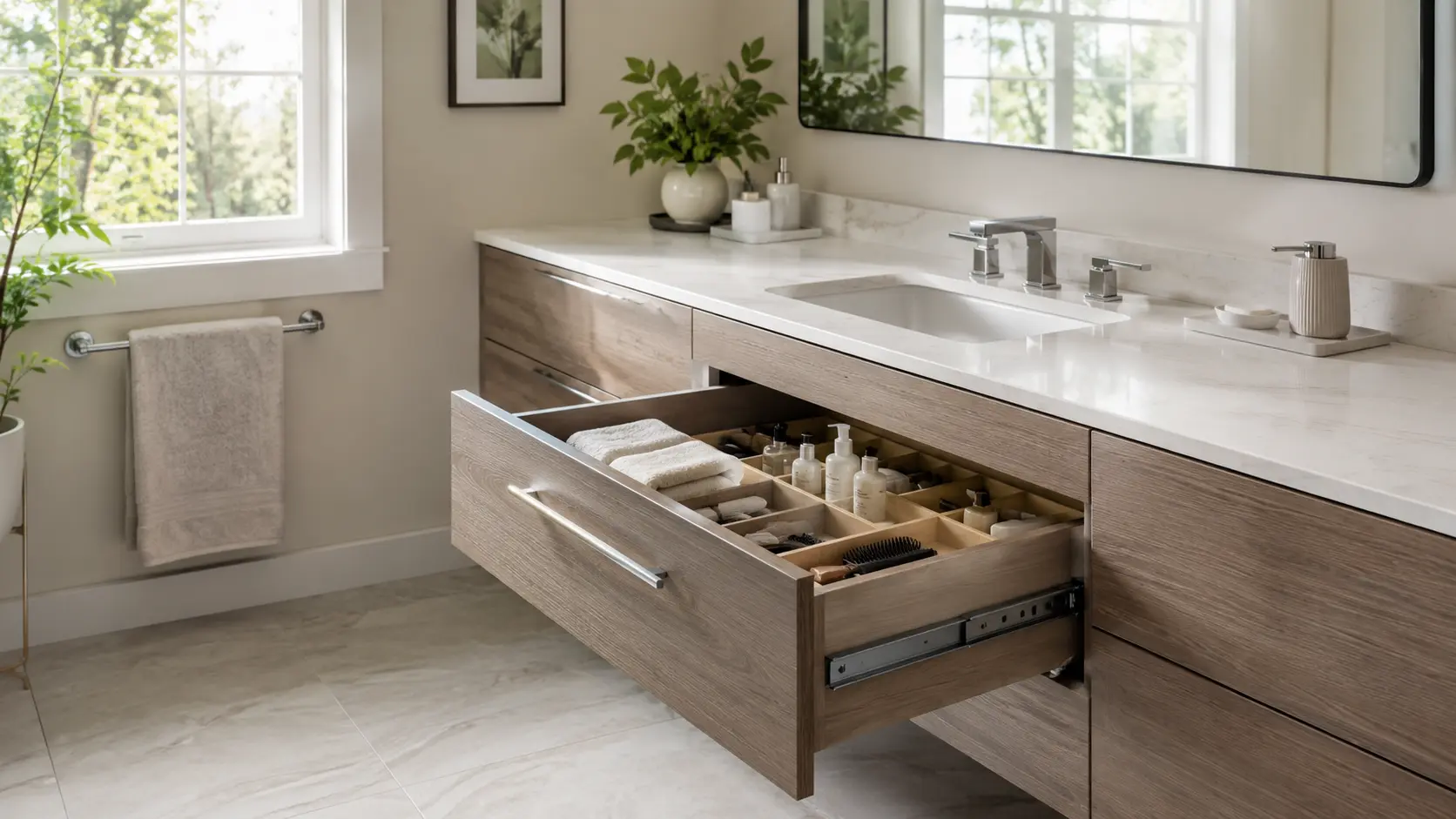
The dimensions of individual drawers determine what can practically be stored in them. A shallow drawer that is the full width of the vanity is ideal for items like hair accessories, makeup, and small personal care products that need to be visible and accessible without digging through a pile of items. A deeper drawer of moderate width is appropriate for hair dryers and similar medium-sized appliances. A very deep drawer near the bottom of the vanity works well for larger items like extra toilet paper rolls, cleaning brushes, and backup product stock.
When a vanity is configured with drawers of appropriate dimensions for the types of items being stored, those items can be stored in a single layer that remains visible and accessible when the drawer is opened. This single-layer visibility is one of the most significant practical differences between good storage and poor storage. Items stored in a single layer in a well-proportioned drawer can be seen and retrieved in a single motion.
Soft close mechanisms in drawer systems use hydraulic dampers to slow and cushion the drawer through the final inch of closing travel. In a bathroom context, this feature matters for storage functionality in ways that go beyond mere convenience.
Drawer contents in a bathroom are frequently lightweight and prone to shifting when drawers are pushed closed with normal force. Items that shift with each drawer closure gradually migrate toward the front of the drawer, creating a piled-up front and an empty back that reduces effective storage capacity. Soft close drawers settle closed with minimal impact force, which means contents stay more consistently organized between uses.
The under-sink zone is the most challenging area of bathroom vanity storage because it is partially occupied by the plumbing components that serve the sink above. The supply lines, drain assembly, and in some cases the P-trap and shut-off valves all occupy space within the cabinet interior that would otherwise be available for storage. How a vanity design handles this zone determines how much of the under-sink space is actually usable and practical.
The doors on the under-sink portion of a bathroom vanity influence not just the appearance of the unit but the practical accessibility of the storage behind them. A two-door configuration on a vanity wider than 24 inches provides better access to the full interior width than a single door, because a single door on a wide cabinet leaves the far interior corner difficult to reach without awkward reaching around the door.
Frameless cabinet construction, which is common in higher quality RTA vanity products, provides a wider door opening relative to the cabinet exterior dimensions than face-frame construction. This wider opening improves the accessibility of everything stored inside, which matters more than it might seem when you are reaching under a sink for something stored at the back of the cabinet.
The back panel of an under-sink cabinet needs openings to accommodate the plumbing components that pass through it from the wall. How these cutouts are designed and sized affects how much of the interior width and depth remains usable for storage. Oversized cutouts that leave large unfinished openings around plumbing components reduce the amount of back panel that is available as a structural surface against which items can be organized. Precisely sized cutouts that accommodate only the plumbing components themselves leave the maximum amount of interior surface intact.
Some RTA vanity designs include removable back panels or modular panel systems that allow the cutout configuration to be customized to the specific plumbing layout encountered during installation. This adaptability means the vanity can be fitted to the actual plumbing configuration rather than requiring the plumbing to be repositioned to accommodate a fixed panel cutout.
The shelving within a bathroom vanity cabinet determines how the interior volume gets divided and what sizes of items can be stored effectively. Fixed shelves at predetermined heights are a limitation of many pre-assembled vanity products. RTA vanities with adjustable shelving systems eliminate this limitation entirely and provide long-term flexibility.
Bathroom products come in an enormous range of heights. A bottle of mouthwash may be 10 inches tall. A can of shaving cream may be 5 inches. A stack of washcloths may be 4 inches high when folded. A large bottle of cleaning spray may be 14 inches. A vanity with fixed shelves at predetermined heights will fit some of these items well and others poorly, wasting vertical space above shorter items and being unable to accommodate taller ones at all.
Adjustable shelving with pin or clip support systems allows shelf heights to be set at whatever positions work best for the specific items being stored. This flexibility means the entire interior volume of the cabinet can be used efficiently regardless of the particular product mix being stored. When storage needs change, the shelves can be repositioned to accommodate the new reality without any modification to the cabinet itself.
Corner placement is one of the most underutilized opportunities in small bathroom layout planning. The corner zone of a bathroom is often left completely unused because standard rectangular vanities do not fit there efficiently. Corner RTA vanity configurations are specifically designed to occupy this zone and make use of otherwise wasted space.
A corner vanity installation positions the plumbing fixture in the corner of the room, where it uses a zone that would otherwise contribute nothing to the usable floor area of the bathroom. This positioning can free up significant wall length on both adjacent walls for other uses, including additional storage, towel bars, or simply more circulation space that makes a small bathroom feel less cramped.
The storage volume of a corner vanity installation can be quite substantial because the cabinet occupies the full depth of both adjacent walls rather than being limited to a single wall depth. This makes it a practical solution for bathrooms with tight or unusual layouts.
Wall-mounted or floating vanity installations represent a different approach to the small bathroom storage equation. They trade some enclosed storage for improved visual space and flexibility, which can be equally valuable in compact environments.
A floating vanity installation leaves the floor beneath the vanity completely visible and uninterrupted. This continuous floor surface creates a visual perception of more floor area in the room.
This perceptual spaciousness improves comfort and usability. A bathroom that feels less cramped is easier to move in and more pleasant to use on a daily basis.
The floor space revealed beneath a floating vanity can serve as practical storage when used thoughtfully. Small baskets or bins can hold extra toilet paper, cleaning supplies, or towels.
It also makes cleaning significantly easier. The ability to clean beneath the vanity without obstruction improves hygiene and reduces maintenance effort over time.
The mirror above a bathroom vanity is one of the most consistently underutilized storage opportunities. A mirror cabinet transforms this space into functional storage without requiring additional floor space.
The depth of a standard medicine cabinet is typically 3.5 to 5 inches, which is enough for most everyday bathroom items. Moving these items from the counter into the cabinet frees up valuable surface space.
When aligned with the vanity, a medicine cabinet creates a layered storage system that improves both accessibility and organization.
The configurability of RTA bathroom vanity systems allows storage solutions to be tailored to specific layouts and user needs. This adaptability is one of the strongest advantages of RTA designs.
Dimension customization allows the vanity to fit precisely in the available space. Configuration customization adjusts drawer and door ratios. Finish customization ensures visual consistency with the rest of the bathroom. Together, these options create a highly efficient and personalized storage solution.
Dimension customization allows the vanity to fit precisely in the available space, while configuration adjustments improve drawer and shelving efficiency. For homeowners looking to better understand how these vanities practically maximize storage capacity in tight layouts, exploring real-world applications and design strategies can provide additional clarity. Together, these options create a highly efficient and personalized storage solution.
In the context of Bathroom Vanities Cleveland, the characteristics of the regional housing market make RTA solutions particularly relevant. Many homes have older layouts with limited storage and non-standard dimensions.
RTA Cabinets Cleveland and similar suppliers address these challenges with flexible designs and installation adaptability. This makes it easier to upgrade storage without major structural changes.
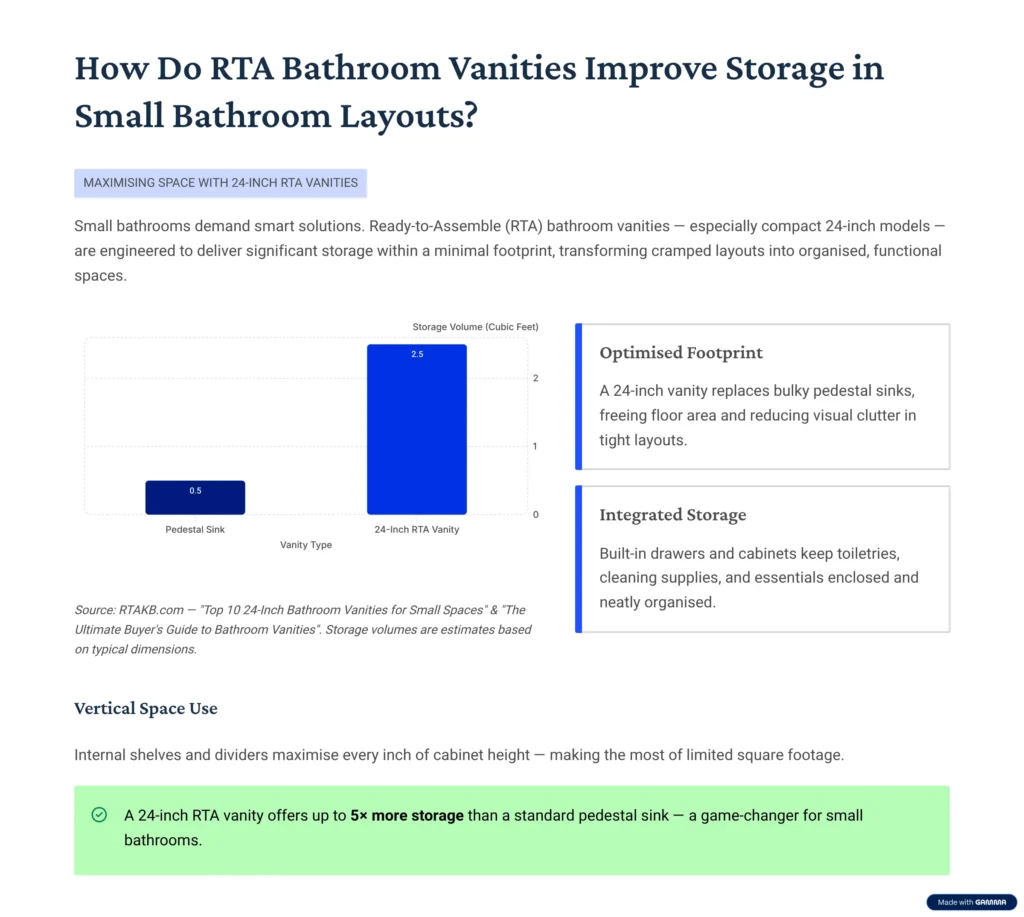
RTA bathroom vanities improve storage in small bathroom layouts through a combination of dimensional flexibility, configurability, and thoughtful interior organization features. The ability to maximize vertical space, optimize drawer configurations, and integrate additional storage elements results in a significantly more functional bathroom.
Even very small bathrooms of 35 to 40 square feet can accommodate meaningful vanity storage if the configuration is chosen appropriately. A narrow vanity with vertical extensions can provide substantial storage without crowding the space.
RTA vanities provide enclosed, humidity-protected storage that is better suited for personal care products. Built-in shelving offers accessibility but less protection. Both work best when combined.
Yes, many RTA vanities include adjustable or modifiable back panels that allow them to fit around existing plumbing configurations. This makes them highly adaptable.
Drawer storage is generally more accessible and easier to organize, while under-sink storage works better for larger or less frequently used items. A combination of both offers the best functionality.
Not necessarily. While it removes some lower cabinet space, it improves usability, cleaning access, and visual openness. In many cases, the trade-off is beneficial for small bathrooms.