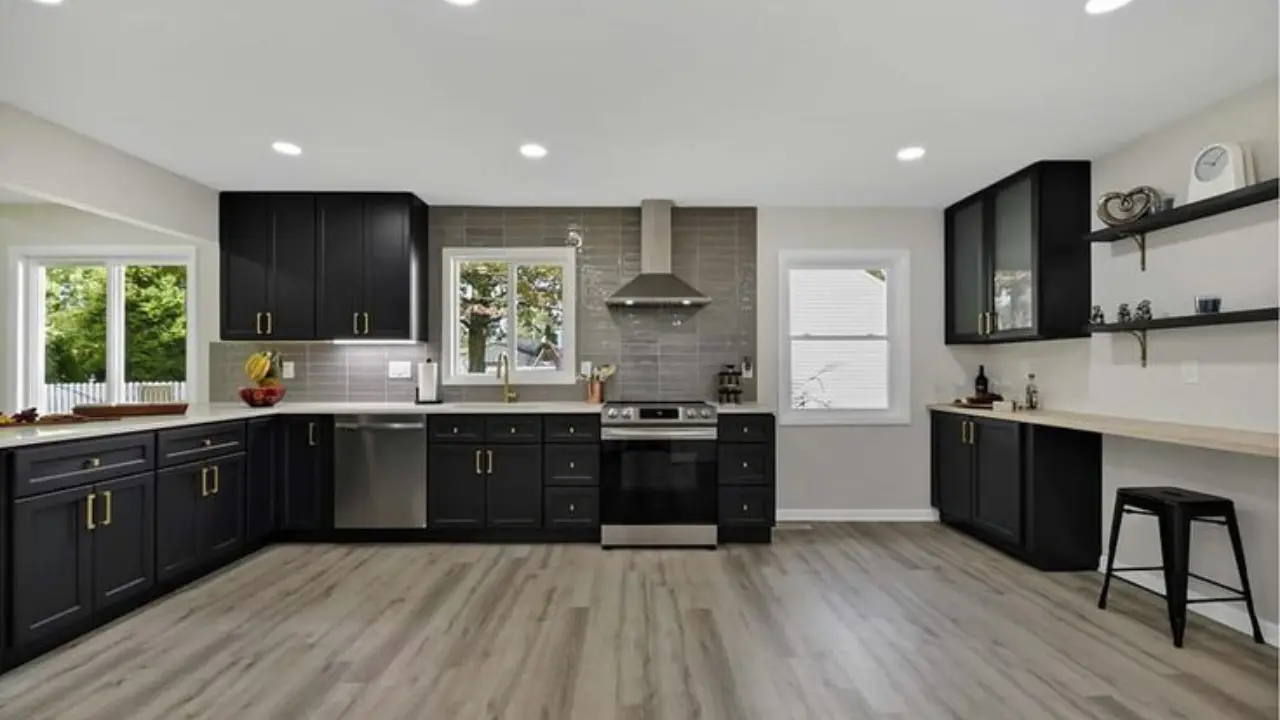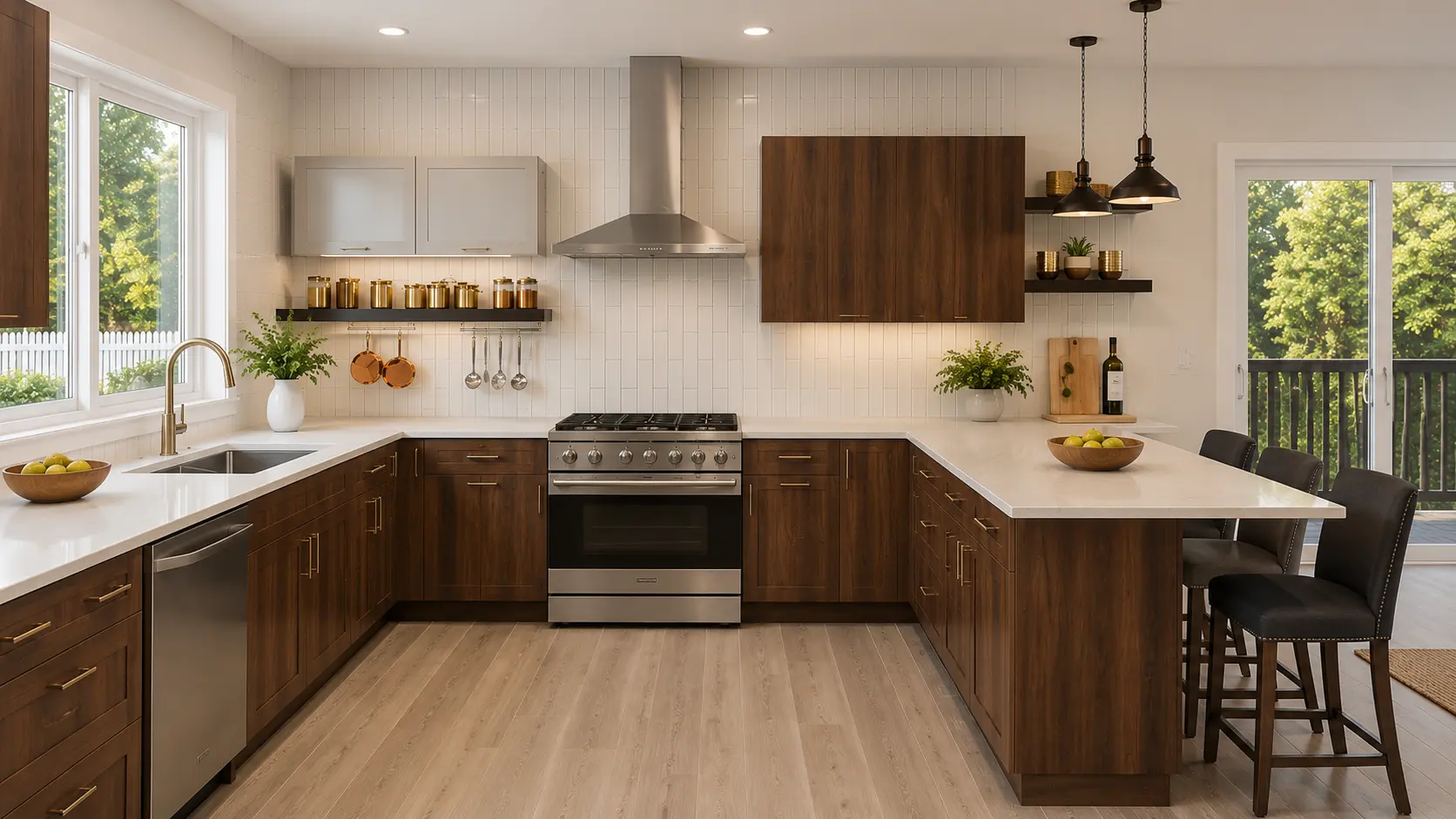
Have you ever watched someone cook in a badly designed kitchen? They walk back and forth like a pinball, opening cabinets on one side of the room only to realize the pot they need is stored on the other side. They set a hot pan down on a counter that is nowhere near the stove. They open a drawer and find random utensils scattered everywhere with no logical organization. Cooking feels exhausting before they even turn on the burner.
Now think about a kitchen that works well. Everything has a place. The pots live near the stove. The mixing bowls live near the prep area. The plates and glasses live near the dishwasher for easy unloading. The cook moves smoothly from fridge to sink to stove without obstacles. That smooth movement is called workflow, and it depends heavily on how your cabinets are laid out and configured.
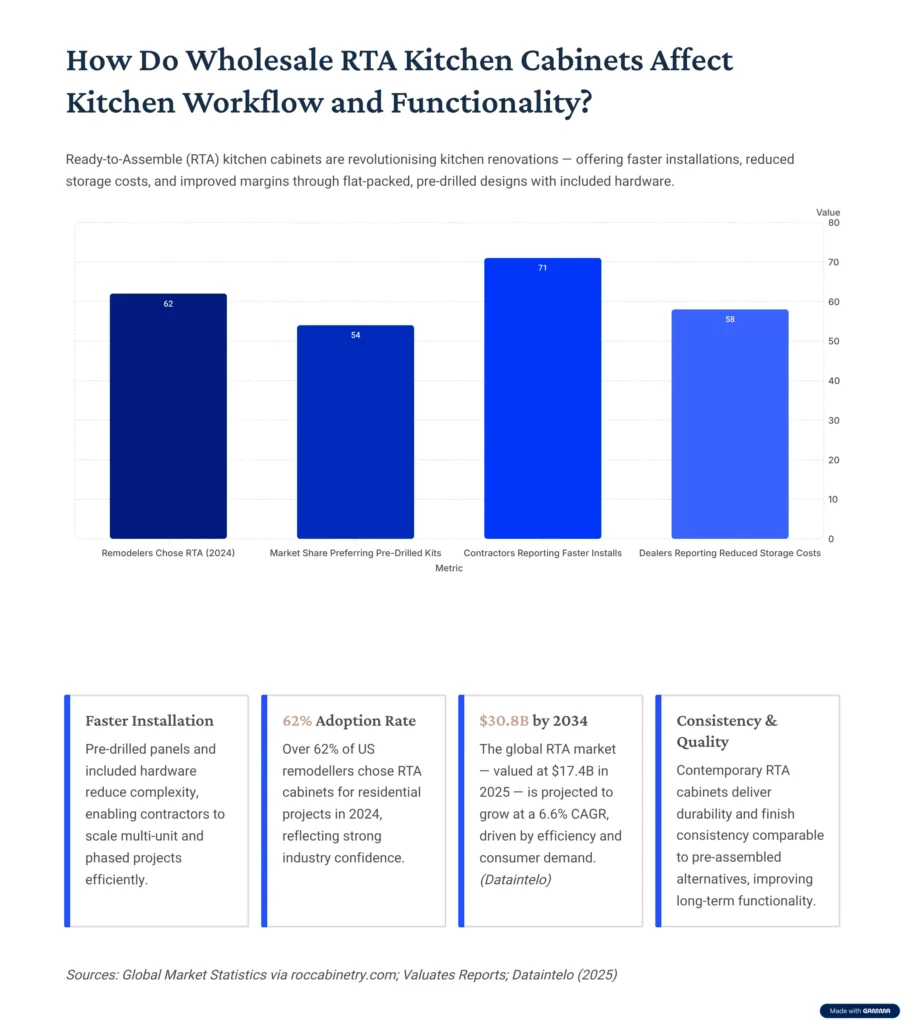
Wholesale RTA kitchen cabinets have a reputation for being budget friendly, but they also offer surprising advantages when it comes to workflow and functionality. The modular nature of RTA cabinets, combined with the wide range of configurations available, means you can build a cabinet layout that supports exactly how you cook.
Before we dive into specific features, let us talk about why cabinets affect workflow at all. Cabinets are not just boxes that hold things. They define where you stand, how you reach, and what you can access quickly.
Imagine a kitchen where all the lower cabinets are on one wall and all the upper cabinets are on the opposite wall. To get a pot, you bend down on one side of the room. To get a lid, you reach up on the other side of the room. To get a spatula, you walk back to the first side. That layout forces you to move constantly, wasting time and energy.
Now imagine a kitchen where the cabinets are arranged in zones. The cooking zone has lower drawers for pots and upper cabinets for spices and oils. The prep zone has lower cabinets for mixing bowls and cutting boards. The cleaning zone has lower cabinets for dish soap and trash bins.
Here is something most people do not think about. Every time you stop moving to find something, you break your flow. Breaking flow means losing momentum. Losing momentum means cooking takes longer and feels more frustrating. Good cabinet design minimizes those flow breaks. You open a drawer, grab what you need, and keep moving. The cabinet serves your movement rather than interrupting it.
RTA cabinets come in a wide range of sizes and configurations, which means you can assign specific cabinet types to specific work zones.
The prep zone is where you chop vegetables, mix ingredients, and assemble dishes before cooking. This zone needs easy access to cutting boards, mixing bowls, measuring cups, and knives. Lower cabinets with deep drawers work well for mixing bowls and cutting boards because you can pull the drawer open and see everything at once. Upper cabinets near the prep zone are good for measuring cups and small prep tools.
RTA cabinets allow you to specify exactly which drawer heights go where. A prep zone drawer should be around six to eight inches deep for mixing bowls. Another drawer of four to five inches works well for measuring cups and spoons. You are not stuck with a default configuration. You build what you need.
The cooking zone centers on your stove or cooktop. This zone needs quick access to pots, pans, lids, spatulas, spoons, tongs, and cooking oils. Lower drawers right next to the stove are ideal for pots and pans because you can grab them without moving away from the heat source. Upper cabinets directly above or beside the stove work for oils, spices, and cooking utensils.
One common mistake is putting pot drawers too far from the stove. Every step you take away from the stove with a hot pot in your hand is a safety risk. Keep your pot storage as close to the cooking surface as possible. RTA cabinets make this easy because you can order a tall drawer base cabinet specifically for pot storage and place it exactly where you need it.
The cleaning zone centers on your sink and dishwasher. This zone needs easy access to dish soap, sponges, trash bins, and recycling containers. A pull out trash bin inside a lower cabinet next to the sink is a game changer. You scrape plates directly into the bin without moving. A lower cabinet with a tilt out front panel works well for sponges and scrub brushes.
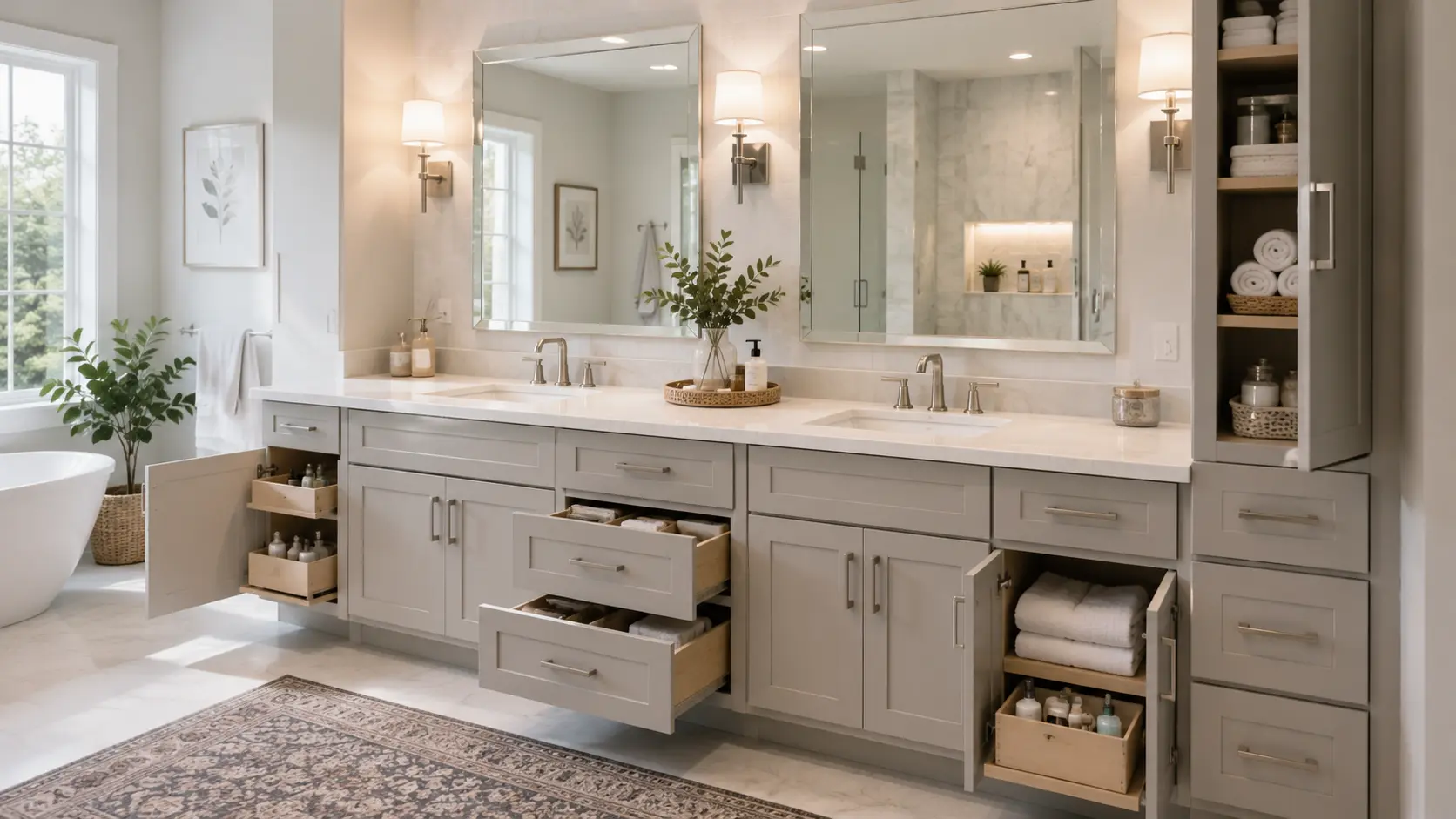
RTA cabinets offer specialized inserts for these purposes. You can order a trash pullout mechanism and install it inside a standard cabinet box. You can add a tilt out tray to a false drawer front. The modular nature of RTA cabinets means you are not limited to what the manufacturer pre builds. You can customize within reason.
Drawers are almost always better than standard shelves for lower cabinets. Let us explain why.
With standard shelves, pots and pans get stacked on top of each other. To reach the pot at the bottom, you must lift everything on top of it. Then you put everything back. It is a hassle, so people often leave pots stacked randomly and struggle to find what they need.
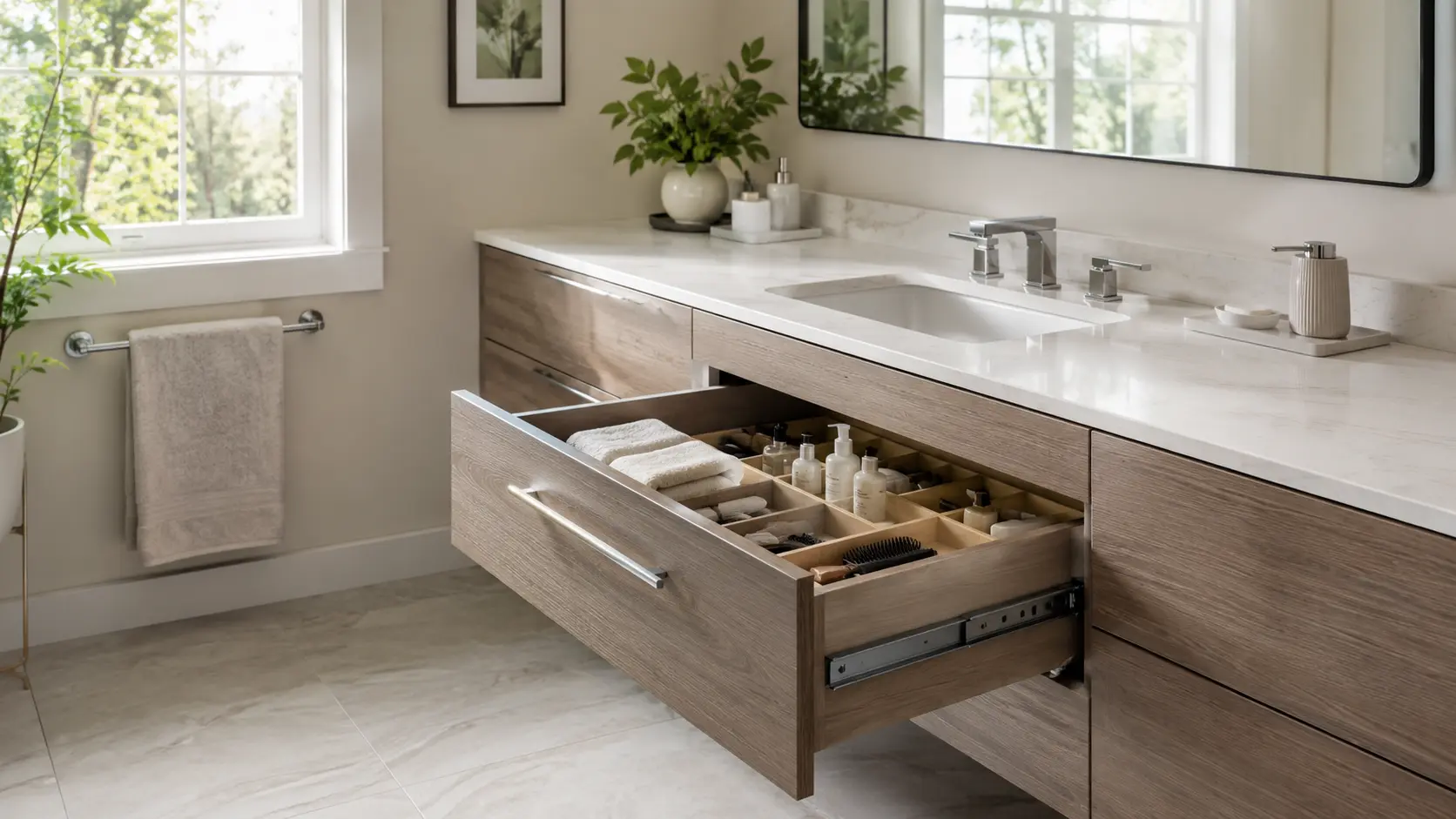
Deep drawers solve this problem. You open the drawer and see all your pots and pans at once. You pull out the one you need. You close the drawer. No stacking. No lifting heavy piles. The efficiency difference is enormous.
Shallow drawers, around two to three inches deep, are perfect for cutlery and cooking utensils. Standard cutlery trays fit inside them. You open the drawer, grab a fork or a spatula, and close it. No digging through crowded crocks on the counter.
The key is placing these shallow drawers in the work zones where you actually use the items. A shallow drawer for spatulas and spoons belongs next to the stove. A shallow drawer for cutlery belongs near the dishwasher so unloading is easy.
Drawers are only as good as their internal organization. A drawer without dividers becomes a jumbled mess over time. You open it and see a tangle of utensils that takes ten seconds to sort through. Ten seconds does not sound like much, but multiply it by twenty times a day, and you have lost real time.
Drawer dividers keep everything in its place. You know exactly where the tongs are. You know exactly where the whisk is. You grab and go. Many RTA cabinet manufacturers offer drawer divider kits that fit their standard drawer sizes. Adding dividers is a small expense that pays off in daily efficiency.
The height of your cabinets, both upper and lower, affects how easily you can reach what you need.
Standard upper cabinets are twelve inches deep. That depth works well for plates, bowls, and glasses. But if you store small items like spice jars or canned goods in upper cabinets, twelve inches is too deep. Items get pushed to the back where you cannot see them. You forget what you have. You buy duplicate spices because you did not see the jar hiding in the back.
Shallower upper cabinets, around nine inches deep, are much more functional for dry goods and spices. Everything stays visible. Nothing gets lost in the shadows. Some RTA cabinet lines offer shallower depth options specifically for this purpose.
Standard lower cabinets are around thirty four and a half inches tall, including the countertop. That height works well for people of average height. But if you are taller or shorter than average, using standard height cabinets can strain your back. Bending down repeatedly to access lower drawers becomes uncomfortable over time.
Some RTA cabinet manufacturers offer different base cabinet heights. You can order taller or shorter cabinets to match your body. This is an advanced consideration, but it matters if you spend a lot of time in your kitchen.
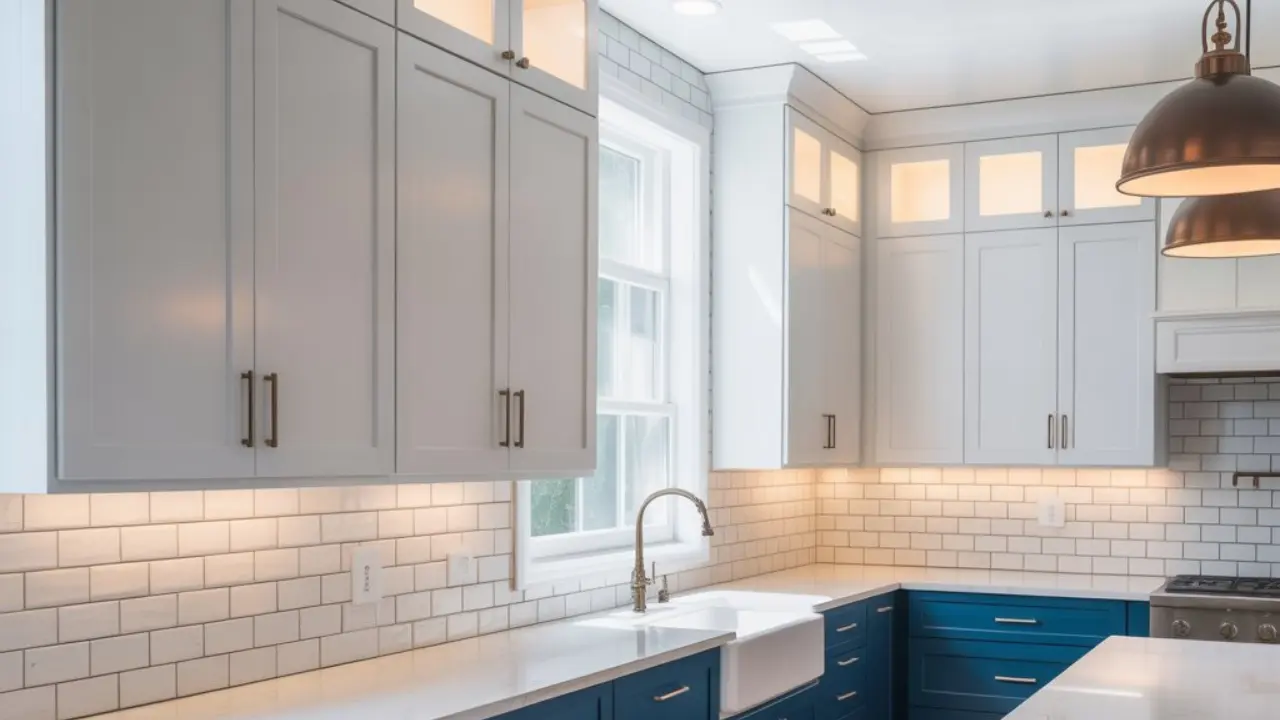
Corner cabinets are the most problematic areas in any kitchen. They are hard to reach, easy to forget, and often become dumping grounds for rarely used items.
A blind corner cabinet is a lower cabinet that turns a corner, leaving a section of the cabinet hidden behind a filler panel. To reach items in that hidden section, you must reach blindly around the corner, which is awkward and uncomfortable. Many homeowners simply give up and leave that space unused.
Lazy Susans, which are rotating shelves, solve the corner cabinet problem. You open the corner cabinet and spin the shelf to bring the back items to the front. Everything becomes accessible.
Pullout corner mechanisms work even better. The entire corner shelf pulls forward and pivots so you can see everything at once. These mechanisms cost more than simple Lazy Susans, but they offer superior access. RTA cabinet suppliers often offer both options as add ons.
The best corner solution depends on your cabinet layout. If you have a full corner with two cabinet doors meeting at right angles, a Lazy Susan works well. If you have a blind corner with only one accessible opening, a pullout mechanism is better. Talk to your supplier about which option fits your specific layout.
Door swing direction seems like a small detail, but it affects how you move through your kitchen.
French doors, which are two doors that open outward from the center, take up less space than a single wide door when open. In a narrow kitchen, a single wide door can block the walkway when open. French doors swing into narrower profiles, keeping the path clear.
French doors also allow you to access half the cabinet at a time. You can open the left door to grab stored items while keeping the right door closed, which keeps the cabinet contents contained.
Sliding doors, sometimes called bypass doors, do not swing outward at all. They slide past each other on tracks. These doors are ideal for tight spaces where outward swinging doors would be impossible. The trade off is that you can only access half the cabinet at a time because one door always covers part of the opening.
The location of your cabinet handles affects which hand you use to open doors and drawers. Handles placed at the bottom of upper cabinets encourage you to open with your palm facing up, which is a natural motion. Handles placed at the top encourage a different grip. These differences seem tiny, but they add up over thousands of openings.
The important principle is consistency. Put all upper cabinet handles in the same relative position. Put all lower drawer handles in the same relative position. You develop muscle memory and stop thinking about opening cabinets at all.
Different kitchen shapes create different workflow challenges. One of the advantages of wholesale RTA kitchen cabinets Cleveland homeowners can access is the ability to customize layouts for any shape.
A galley kitchen has two parallel walls with a walkway between them. Workflow in a galley kitchen is linear. You move from one end to the other. Cabinets in a galley kitchen should put the sink and dishwasher on one wall and the stove and refrigerator on the other wall. This arrangement creates a natural order. You bring groceries in, store them, wash produce, prep on the counter, cook on the stove, and clean up at the sink.
An L shaped kitchen has two perpendicular walls. The corner where the walls meet is the natural pivot point. Workflow in an L shaped kitchen involves turning the corner frequently. Making that corner efficient is essential. A good L shaped kitchen puts the sink on one leg and the stove on the other leg, with the corner as the prep zone. You turn from the sink to the prep corner, then turn again to the stove.
A U shaped kitchen has three walls of cabinets. This shape offers the most storage but can create workflow problems if the legs of the U are too long. Walking from one leg to the other becomes a long trip. The solution is to put the stove on the center wall and the sink and refrigerator on the side walls. This arrangement keeps the most used items within a few steps.
RTA cabinets are modular by nature. That modularity offers real workflow advantages.
Standardized cabinet sizes mean you can predict exactly how tall, wide, and deep each cabinet will be. That predictability makes it easier to plan your layout around your specific movement patterns. You are not guessing how much space a weird sized cabinet will take up. You know the dimensions, so you can design with precision.
You can mix different cabinet heights to define different work zones. For example, you might use taller upper cabinets near the pantry area and shorter upper cabinets near the window. The change in height signals a change in function without walls or barriers. Your brain subconsciously understands that tall cabinets mean dry goods and short cabinets mean everyday dishes.
Because RTA cabinets are modular, you can add components later without redoing the whole kitchen. Need a trash pullout in a cabinet that currently has plain shelves? You can order just the pullout mechanism and install it. Need to add a drawer divider kit? You can order it separately. This flexibility means your kitchen can evolve as your cooking habits change.
RTA Cabinets Ohio emphasizes workflow in their cabinet configurations. They offer a wide range of drawer heights, specialized inserts, and corner solutions specifically chosen to improve kitchen functionality. Their design consultants ask about how you cook, how you move, and what frustrates you about your current kitchen. Those answers guide the cabinet selection.
Consider a homeowner who used to store pots on a shelf behind closed doors. Pots were stacked haphazardly. Finding the right pot meant lifting three others. After switching to deep drawers in the cooking zone, that same homeowner now opens one drawer, sees every pot, and grabs the right one instantly. Daily cooking frustration disappeared.
Consider another homeowner who stored spices in a deep upper cabinet. Spices got pushed to the back and forgotten. Meals were missing key flavors because the homeowner did not know what spices they had. After installing a shallow upper cabinet specifically for spices, every jar stays visible. Cooking became more flavorful and less wasteful.
The dishwasher needs to be close to the sink because you rinse dishes before loading them. If the dishwasher is too far away, you carry dripping wet dishes across the kitchen, leaving a trail of water. The ideal dishwasher placement is directly next to the sink.
Glasses belong near the refrigerator because that is where you fill them with cold drinks. If glasses are stored across the kitchen, you walk from the fridge to the glass cabinet, then back to the fridge to fill them. That is unnecessary movement. Store glasses in the upper cabinet closest to the refrigerator.
The work triangle connects the sink, stove, and refrigerator. No side of this triangle should be longer than nine feet, and no cabinet should block the straight line path between any two points. Tall pantry cabinets are especially problematic because they stick out into the work path. Position tall cabinets outside the work triangle, along a wall where you do not need to walk frequently.
Kitchen cabinets are not just storage. They are tools that shape how you move, how quickly you work, and how much you enjoy cooking. Wholesale RTA kitchen cabinets offer the flexibility to build a layout that fits your exact workflow needs. Drawers instead of shelves. Strategic drawer heights. Corner solutions that actually work. Door swings that keep your path clear. These details add up to a kitchen that feels effortless to use.
The best kitchen is not the one with the most expensive cabinets. It is the one where you can cook without thinking about where things are, because everything is exactly where it should be.
Yes, within the constraints of standard cabinet sizes. RTA cabinets come in standardized widths, typically increments of three inches from nine to forty eight inches. You can combine these widths to achieve almost any layout. Custom sizes are not available, but the standard sizes cover most layouts.
Think about what you will store in each drawer. Deep drawers of nine to twelve inches work for pots, pans, and small appliances. Medium drawers of six to eight inches work for mixing bowls and food storage containers. Shallow drawers of three to five inches work for utensils, cutlery, and spices.
For many homeowners, yes. Corner pullouts bring items completely out of the cabinet so you can see everything at once. Lazy Susans rotate, which is better than nothing, but items still hide behind each other. If you cook frequently and use corner storage often, the pullout is worth the investment.
The standard distance is eighteen inches between the countertop and the bottom of the upper cabinets. This height accommodates most countertop appliances without blocking access. Taller homeowners may prefer nineteen or twenty inches for better visibility into pots and bowls on the counter.
Yes and no. You can change drawer configurations, add dividers, or install pullout mechanisms after the fact. You cannot change the physical placement of the cabinets without removing and reinstalling them. Plan your layout carefully before ordering because moving cabinets later is difficult and expensive.