

Not every bathroom vanity that looks solid actually is. Behind a painted door, the cabinet box can be real plywood or it can be pressed wood chips that fall apart the first time steam gets in. This guide walks through six quick checks anyone can run in a showroom or in their own bathroom, and explains why the difference matters more than the color or the hardware.
A vanity can look identical on the showroom floor and behave completely differently five years later. The paint, the hardware, and the countertop are not what decides how long a vanity lasts. Two vanities can share the same door style, the same soft-close hinges, and the same price tag on a sale weekend, and still age at completely different speeds once they get home.
The core is the material behind the painted or laminated surface. It is the wood, or wood substitute, that the doors, drawer fronts, and cabinet box are actually built from. Plywood, particleboard, and MDF can all wear a nearly identical finish, right down to the same shade of white paint or the same wood-look laminate. A shopper standing in front of a closed vanity door has almost no way to tell them apart just by looking at the front.
That’s exactly why so many homeowners find out the hard way, months or years after the return window has closed. The finish is a coating. The core is the structure. One protects the eye, the other protects the investment.
A kitchen cabinet deals with the occasional spill, a splash from the sink, maybe a pot of boiling water nearby once in a while. A bathroom vanity deals with steam every single day, splashes at the sink multiple times a day, a supply line and a drain line just inches from the cabinet floor, and a household of towels, hair products, and cleaning sprays stored right inside it.
That daily cycle of humidity and drying is what separates a cabinet that lasts decades from one that fails in a few years. Kitchen cabinets can sometimes get away with a weaker core because the environment is more forgiving. Bathrooms rarely offer that same grace period.
Particleboard is one of the most common cores hiding behind a painted bathroom vanity front, especially at the lower end of the market.
Particleboard is made from small wood chips and sawdust bonded together with resin under pressure. It is affordable to produce, which is exactly why it shows up so often in budget vanities, especially at big box stores where price per square foot drives most buying decisions. On day one, a particleboard vanity can look every bit as good as a plywood one, sometimes better, since the flat, uniform surface takes paint and laminate cleanly.
MDF, or medium-density fiberboard, is a close cousin worth knowing too. It is made from finer wood fibers pressed with resin into a smooth, dense panel. MDF is denser and slightly more stable than particleboard, and it is popular on painted vanity doors because it has no visible grain to interrupt a smooth paint job. But MDF shares the same core weakness as particleboard once water is involved.
Particleboard has very little margin for error around moisture. Once water reaches an unsealed cut edge or a plumbing cutout, it wicks in like a sponge. The core swells, crumbles, and never returns to its original shape, even after it eventually dries out. Doors stop closing evenly. Drawer bottoms sag in the middle. Hardware screws start spinning loose in a hole that no longer holds, because the fibers around the screw have already broken down.
This damage rarely happens all at once. It creeps in slowly, starting at the corners and the plumbing cutout, then working outward, which is exactly why so many homeowners don’t notice a problem until the vanity is already several years old and hard to fix without a full replacement.
Bathrooms are humid almost by design.
90%peak humidityA hot shower can pushbathroom humidity above 90%for several minutes at a time
Plywood is a completely different kind of material, built to handle exactly the kind of daily stress a bathroom throws at it.
Plywood is built from thin layers of real wood veneer, glued together with each layer’s grain running in an alternating direction. That cross-laminated structure is what gives plywood its strength in every direction at once, not just along a single grain line. It is still, at its core, a real wood product rather than a resin-and-fiber panel pressed into shape.
Not all plywood is graded the same way, either. Cabinet-grade plywood with tight, void-free layers and waterproof glue performs best in a wet environment like a bathroom. Lower grades with internal voids or weaker adhesive give water somewhere to travel once it gets past a cut edge, so the grade matters almost as much as the material itself.
Because the grain alternates layer by layer, plywood resists the swelling and warping that plagues particleboard and MDF. Understanding these plywood and particleboard differences in cabinets helps explain why the material holds a screw firmly, keeps hinges tight, and stays dimensionally stable across a wide panel as bathroom humidity rises and falls throughout the day. Where particleboard breaks down at the fiber level once wet, plywood’s layered structure gives it something to fall back on, so a small amount of moisture exposure does not automatically mean structural failure.
That difference shows up most clearly at stress points: the hinge screws that get opened and closed multiple times a day, the drawer slides carrying the weight of towels and toiletries, and the corners of the sink base where a small drip is almost inevitable over the years.
None of these checks require tools. They take a few minutes at a showroom or in your own bathroom.
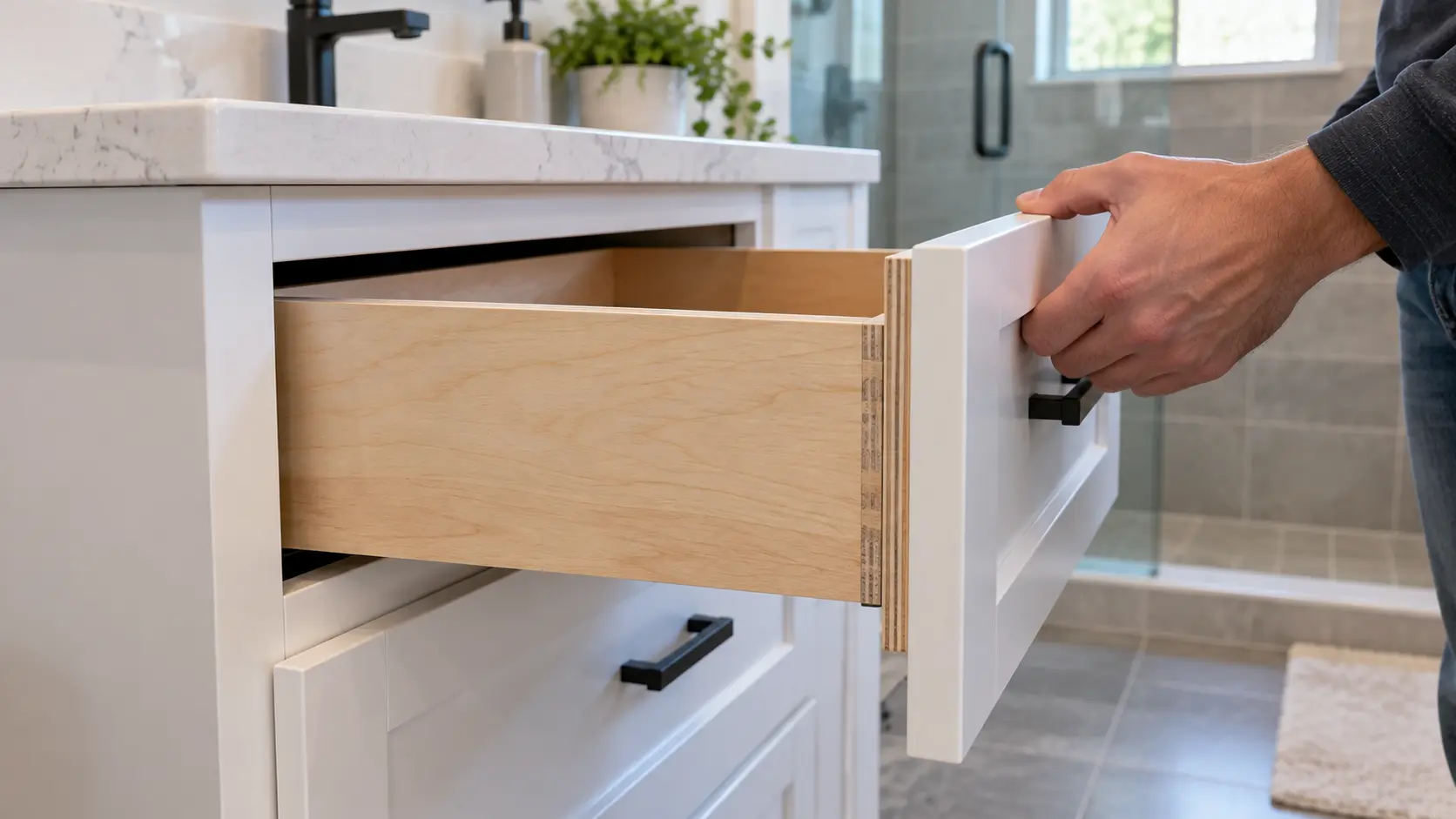
Plywood is noticeably heavier and denser than particleboard of the same size. Lift a drawer out of its slides. A plywood drawer box feels solid in the hand, with a bit of heft even when it’s empty. A particleboard box feels light and slightly hollow, almost like it’s built from cardboard with a wood-look wrapper.
This test works well in a showroom, where a shopper can compare two similarly sized vanities side by side. The lighter one is worth a second, closer look before it comes home.
Open a door or drawer front and look at any exposed or unfinished edge, often on the inside of a cabinet or drawer, or along the back panel where the finish usually stops. Plywood shows thin, visible layers stacked like a very tight sandwich, sometimes five, seven, or more distinct layers depending on the panel thickness. Particleboard looks like compressed sawdust with no visible layering at all, just a uniform, speckled cross-section.
This single check is often the fastest and most reliable of the six, since it requires nothing more than opening a door and looking closely at an edge that’s normally hidden from view.
Look at where a hinge or drawer slide is screwed into the cabinet. Plywood holds a screw tightly because the layered grain grips threads from multiple directions at once. Particleboard often shows a slightly enlarged or crumbly hole around the screw, a sign the material has already started to give under repeated opening and closing.
On a used or older vanity, gently wiggle a hinge by hand. If it feels loose or the screw spins in place without resistance, that’s a strong signal the surrounding material has weakened, whether from age, moisture, or simply being particleboard from day one.
The area under the sink base takes the most moisture exposure of any part of a vanity, thanks to the plumbing cutout and any small drips over time. Open the doors and look at this panel specifically, running a hand across the surface if it’s within reach. Swelling, discoloration, bubbling paint, or a soft, spongy feel here almost always points to particleboard or MDF, not plywood, since plywood tends to hold its shape even after minor moisture exposure.
This is also the single most useful spot to check on a vanity that’s already installed, since it tells you how the material is actually holding up in real conditions, not just how it looked on the showroom floor.
Plywood veneer often shows a faint but real wood grain pattern, even under paint, if you look closely at an edge or a corner where the finish is thin. Particleboard has a uniform, speckled, almost sandy texture with no grain at all, because there is no continuous wood fiber running through it, just bonded chips and resin.
Good lighting helps here. A flashlight held at a low angle across an edge or corner will usually reveal the difference within a few seconds.
If a showroom associate cannot answer a direct question about the cabinet box material, that is itself useful information. A cabinet builder who uses real plywood usually says so plainly, without redirecting the conversation to the finish, the hardware, or the countertop instead. It’s a simple, direct question, and a confident, specific answer is a good sign no matter where you end up buying.
Most stock vanities on the market lean on the cheaper option.
Typical Stock Vanity Coresparticleboard or MDF, roughly 70%real plywood or solid wood, roughly 30%
Understanding why particleboard fails helps explain why the checks above actually matter.
Every hot shower sends humidity climbing, then the exhaust fan or an open window brings it back down. That cycle repeats multiple times a day, every day, for as long as the vanity is in use. Materials that cannot handle repeated swelling and drying eventually lose their shape for good, even without a single dripping pipe or overflowing sink ever touching them directly. Steam alone, over months and years, is enough to start the process.
The hole cut for the supply lines and drain is one of the most exposed points on any vanity. If that cut edge is not fully sealed, and it often is not on budget particleboard units, water finds its way straight into the core. This is usually where swelling and soft spots show up first, long before any damage becomes visible from the front of the cabinet.
A good exhaust fan reduces how much humidity a vanity has to deal with in the first place, and it’s worth running during and after every shower regardless of what material the cabinet is built from. Plywood tolerates humidity far better than particleboard, but no cabinet material benefits from sitting in trapped steam for longer than necessary. If you want to browse durable construction styles before visiting, you can see plywood vanity options online to compare builds and finishes. Pairing a quality vanity with reasonable ventilation is the combination that actually maximizes how long either material lasts.
A plywood cabinet box typically costs only a modest amount more than a particleboard equivalent of the same size and style. That small difference upfront is nothing compared to what a full vanity replacement costs once a particleboard core fails.
$665+typical labor cost alone to replacea failed bathroom vanity
Paying a little more for plywood once usually costs less than paying to replace a swollen particleboard vanity a few years down the road.
Every bathroom vanity we sell is built with premium all-plywood construction, box, doors, and drawers alike. No particleboard, no shortcuts, no guessing what’s behind the paint. That’s true whether it’s a single-sink vanity for a small guest bath or a larger double-sink layout for a shared master bathroom.
If you’re comparing vanities and want to skip the guesswork entirely, you can shop bathroom vanities built with real plywood directly, backed by a 6-year warranty and up to 50% off pricing. Free in-person design help is available at our Cleveland warehouse too, walk-ins welcome, no pressure, no appointment required.
Beyond the six checks above, a few extra questions can save a lot of frustration later.
A real plywood builder can usually show a cut sample or a floor display with an exposed edge. If a showroom cannot produce this, that is worth noting.
A short or vague warranty is sometimes a signal that a builder is not confident the core material will hold up long term. A longer warranty on the cabinet box itself is a better indicator of real construction quality.
Dovetailed or well-joined plywood drawer boxes hold up far longer than stapled particleboard boxes. Pull a drawer fully out and look at how the corners are joined before you decide.
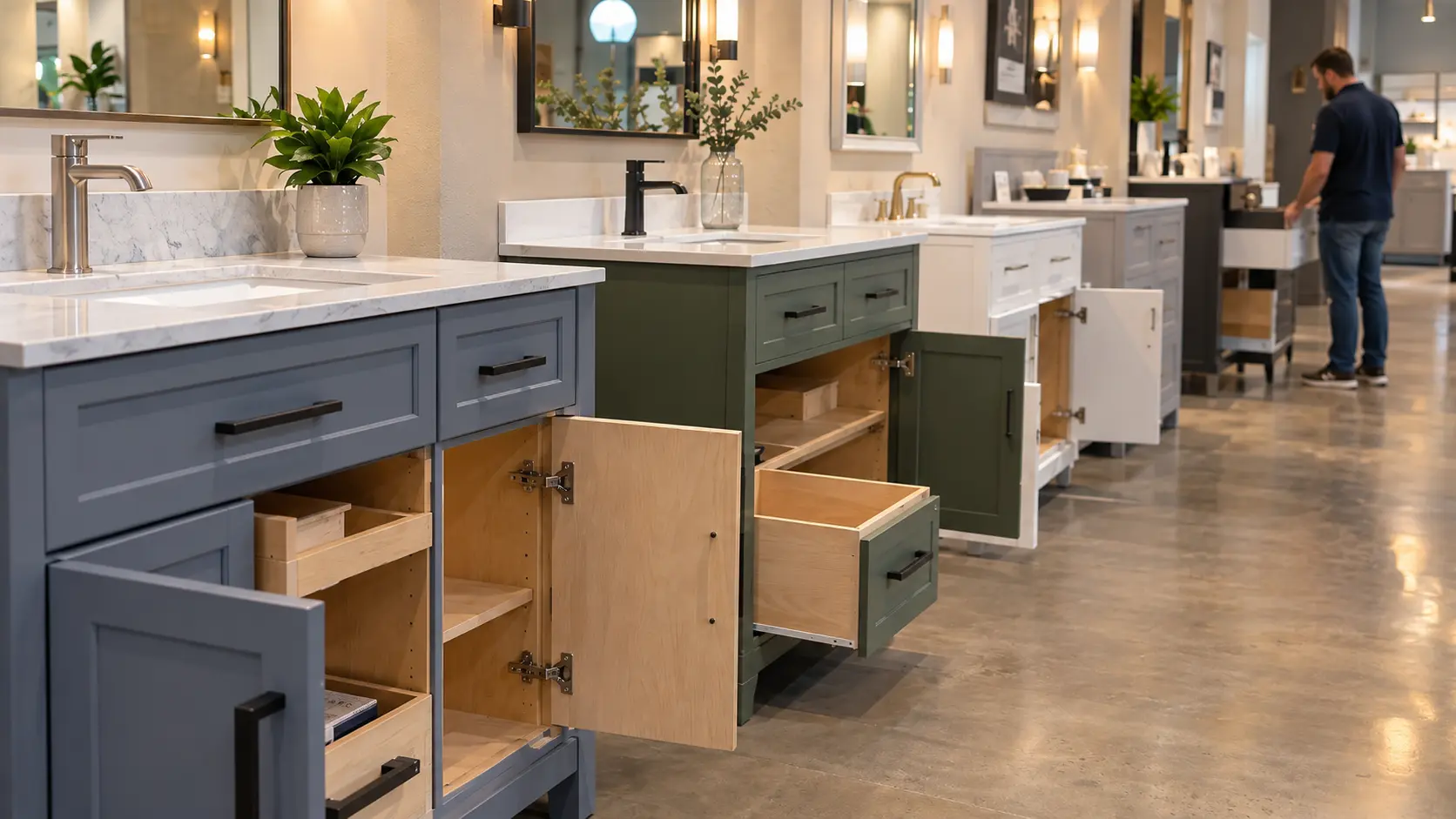
Homeowners near Munn Park, along Rocky River Dr and Munn Rd, and throughout the Kamm’s Corners area can see real plywood construction in person at our Cleveland warehouse, located at Latitude 41.4587884, Longitude -81.8144045. Walk-ins are always welcome for a free design consultation.
Get bathroom vanity Kamm’s Corners services now.
Can you tell if a bathroom vanity is plywood just by looking at it?
Sometimes, but not always from the front. A painted or laminated finish can hide either material equally well. The most reliable way is to check an exposed edge, a drawer box, or the panel under the sink base, where the real core is visible.
Is particleboard really that much weaker than plywood for a vanity?
Yes. Particleboard has far less resistance to moisture and far less screw-holding power than plywood. Once water reaches the core, particleboard swells and crumbles in a way that plywood generally does not.
Do all RTA vanities use particleboard?
No. “RTA” only means ready-to-assemble, it says nothing about the material inside. RTA Cabinets Ohio builds every RTA and pre-assembled vanity with premium all-plywood construction, never particleboard.
How long does a particleboard vanity typically last in a humid bathroom?
It varies with how much steam and moisture the bathroom sees daily, but particleboard cores are the first to show swelling, sagging, or crumbling at cut edges, often well before a comparable plywood vanity shows any wear at all.
Where can I see real plywood vanities in person near Kamm’s Corners?
Our Cleveland warehouse is a short drive from Kamm’s Corners, near Munn Park at Rocky River Dr and Munn Rd. Walk-ins are welcome Monday through Friday for a free, no-pressure design consultation.